Every 1 November, coinciding with All Saints’ Day, the sky above Sumpango is transformed into a canvas of colours. The reason? The Sumpango Festival, one of Guatemala’s most astonishing artistic and spiritual events. The visual impact on first-time visitors is undeniable, but the event is about much more than just colour.
The Sumpango Giant Kite Festival, as it's also known, is steeped in mysticism and a connection to the ancestors. So, if your trip to Guatemala coincides with the festival dates, I urge you to do your best to see it. In this guide, we’ll help you by telling you everything you need to know about the event, as planning is essential given the huge crowds that attend.
What is the Sumpango Festival?
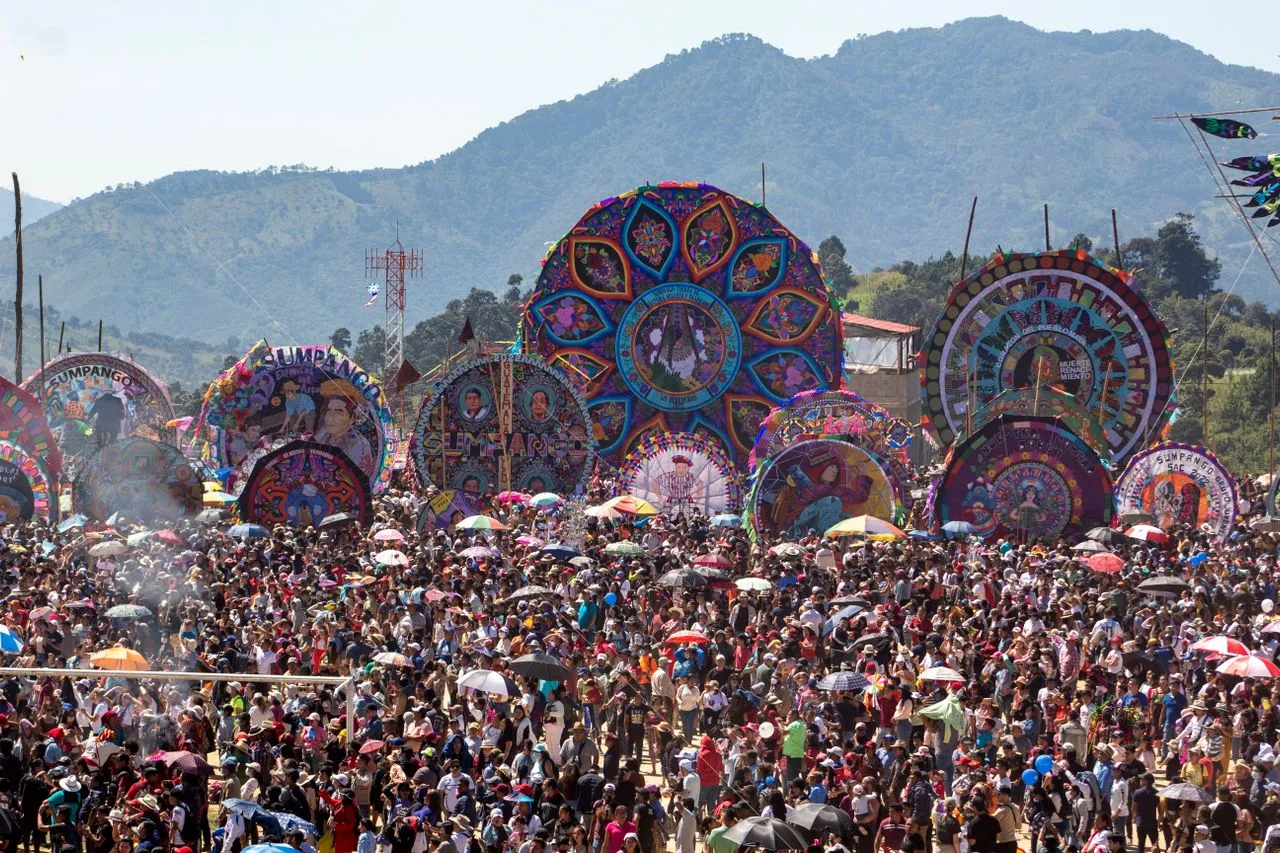
The Sumpango Festival is an event held on the first day of November, which involves erecting giant circular kites, known as ‘barriletes’. These are made from tissue paper and are entirely handcrafted. They can measure up to 20 metres in diameter and, apart from their size, what stands out most about them is their vibrant colour and the figures and designs depicted on them.
The significance of this Guatemalan tradition
The Sumpango Giant Kite Festival has its origins in the local Kaqchikel Maya community. For them, kites are sacred channels of communication that connect the world of the living with the afterlife. Furthermore, they were also created as a protective shield to ensure peace for the deceased. That is why, as the festival’s grand finale, the kites are burnt at nightfall so that the souls do not remain trapped on earth.

Furthermore, they are a symbol of cultural resilience, as the designs on the kites tell the story of the people. They also depict social and political issues, whilst others pay homage to Mother Earth.
The link between kites and All Saints’ Day
The fact that these two dates coincide is no coincidence, but rather the result of the widespread religious syncretism in the country. Before the arrival of the Spanish, the Maya people already commemorated their dead using a more rudimentary form of kites, but with colonisation, Catholic festivities were imposed. However, to facilitate conversion, indigenous traditions were allowed to continue and were integrated with Catholic practices.
In this way, the Maya people adopted the colonists’ Catholic festival calendar, whilst retaining part of their own cosmology. Furthermore, the Sumpango festival, in particular, has a meaning very similar to All Saints’ Day, albeit with its own distinctive features, of course. The Maya believe that on that very day, their ancestors can visit the world of the living, so the kites guide them to their homes, ensuring that their visit passes peacefully.
Why it's one of Guatemala’s most important festivals
The history and traditional craftsmanship behind the Sumpango Festival are so valuable that UNESCO officially recognized it as Intangible Cultural Heritage of Humanity. Furthermore, alongside other events such as Holy Week in Antigua Guatemala, the festival is one of the finest expressions of cultural identity, Mayan resilience and spiritual syncretism.
As with other festivals in the country, the Sumpango festival also plays a major role in bringing the local community together. On the one hand, it takes between 15 and 20 people to make the kites, which are over 10 metres in diameter. But, moreover, it's the communities themselves that fund the materials and design the intricate patterns.
The festival’s evolution over the generations
The Sumpango festival as we know it today emerged between the late 19th and early 20th centuries. Originally, the villagers would create small circles by joining and weaving together banana leaves. Over time, and thanks to the introduction of tissue paper, these structures were able to grow in size.
But the real change that gave the festival its impetus came in the second half of the 20th century, when craftspeople, families and the community began to organise themselves more formally. Little by little, the Sumpango festival evolved into a full-fledged artistic competition, even featuring different categories.
Where does the Sumpango Festival take place?
The Sumpango festival is mainly held at the municipal football ground, which is right next to the cemetery. This large space allows the kites to be assembled and launched, making perfect use of the air currents.
Location of Sumpango, Sacatepéquez
The municipality of Sumpango is part of the department of Sacatapéquez. Its altitude and mountainous terrain create the perfect wind conditions for flying giant kites.
How to get there from Antigua Guatemala
Antigua Guatemala, due to its popularity and proximity to Sumpango, is the most common starting point for travellers heading to the Sumpango festival. The journey takes about half an hour by car or bus, and it's best to book a private return transfer. You can even choose to book an Uber, which operates in the country.
How to get there from Guatemala City
In this case, I’d also suggest booking an organised day trip or private transfers. On a normal day, the journey takes no more than an hour, but due to traffic it can take up to three or four hours. It’s therefore advisable to set off early to avoid the traffic jams.
When does the Sumpango Giant Kite Festival take place?
It's observed without fail on 1 November each year, coinciding with All Saints’ Day.
Event timetable and programme
Usually, between six and eight in the morning, the kites are assembled on the football pitch; and from eight until twelve, they are raised vertically so that the public can admire them. From 1 pm, the flying competition takes place until around half past four. Finally, from 5 pm to half past six, the kites are taken down and burnt to ensure that the souls return peacefully to the afterlife.
When is the best time to attend?
Personally, I’d recommend arriving before eight, as that’s when the main influx of tourists starts and access to the field can become congested. During this early period, you’ll have the chance to watch the craftspeople and artists assemble the kites, which is also well worth seeing. However, if you’re only interested in the flying itself, you can head to the field between one and three in the afternoon.
- We invite you to read our article about the Flower Festival in Antigua Guatemala.
Why are giant kites flown in Sumpango?
The reason for flying giant kites lies in the need to keep alive the bond that links the living with their departed loved ones. Furthermore, as they soar majestically into the sky, they act as beacons, guiding the souls along the right path back to their former homes.
It's also customary to tie small pieces of paper to the strings holding the kite. It's believed that, as the kite flies, these messages travel directly to heaven to be read by the deceased.
What are the giant kites of Sumpango like?
Dimensions and characteristics of kites
There are two categories in the kite competition: the ‘monumental’ kites, which are the largest at the festival, measuring between ten and twenty metres in diameter and remaining aloft throughout the day; and the flying kites, which range in diameter from four to eight metres and whose flight is one of the most eagerly anticipated spectacles of the festival.
The materials used in its manufacture
The frame of the kites is made of bamboo or castilla cane, whilst the base onto which the designs are applied is made of rice paper. Finally, the fringes are made of braided paper or plastic
The community work behind every design
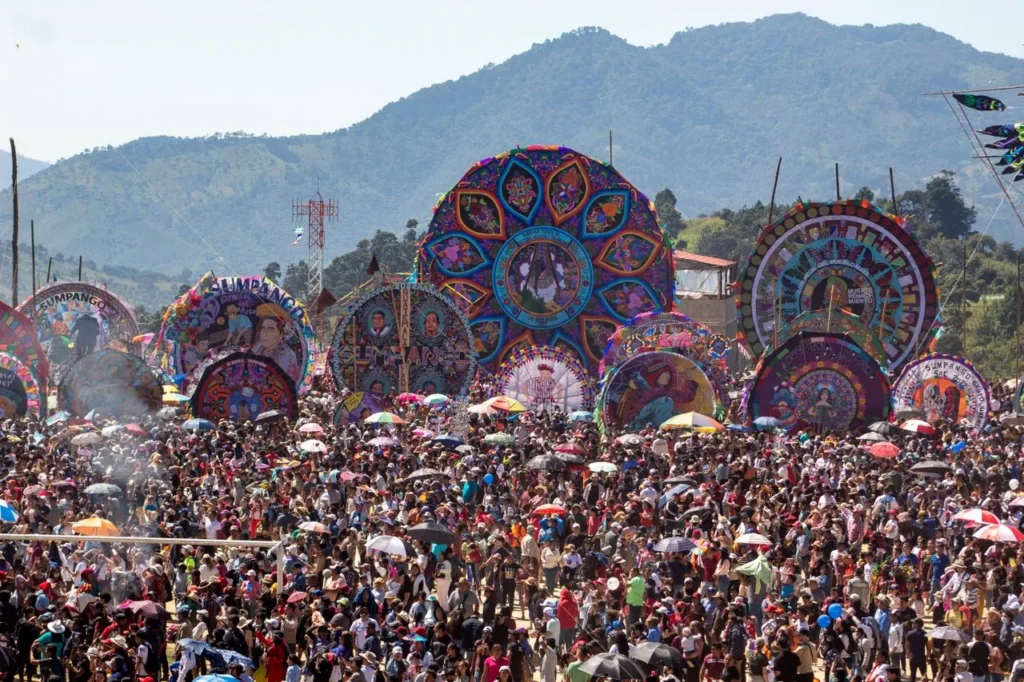
To create the giant kites, the craftspeople and artists begin their work between four and six months in advance. However, this is not their main occupation; rather, they are young people, family members or friends who get together after work or school to keep this tradition alive.
- We invite you to read our article about San Lucas, Sacatepéquez.
The meaning of the designs and messages on the kites
Social, cultural and environmental issues
The Sumpango Festival is an opportunity for the communities in the municipality to share their thoughts, concerns and cultural roots with thousands of spectators. In recent decades, it has also evolved into a platform for speaking out and raising awareness. Today, the themes centre on highlighting social and political issues (such as an end to corruption, respect for indigenous rights, an end to violence and the promotion of women’s rights).
Environmental issues are also often addressed through depictions of endangered wildlife, calls to halt deforestation, or warnings about climate change. Finally, scenes from everyday life are often depicted as a means of cultural preservation.
Mayan elements featured in the designs
Pre-Hispanic iconography and the Mayan worldview permeate every canvas, as they incorporate many sacred elements and geometric patterns so characteristic of this culture.
What to do during the Sumpango Festival
Admire the giant kites
The barrels are the main attraction at the Sumpango festival. The ritual for every spectator is to stroll around the football pitch whilst the craftspeople and artists erect the structure, and then, in the afternoon, to watch as some of them are hoisted aloft whilst others remain standing, displaying their beautiful designs.
Enjoying cultural and artistic activities
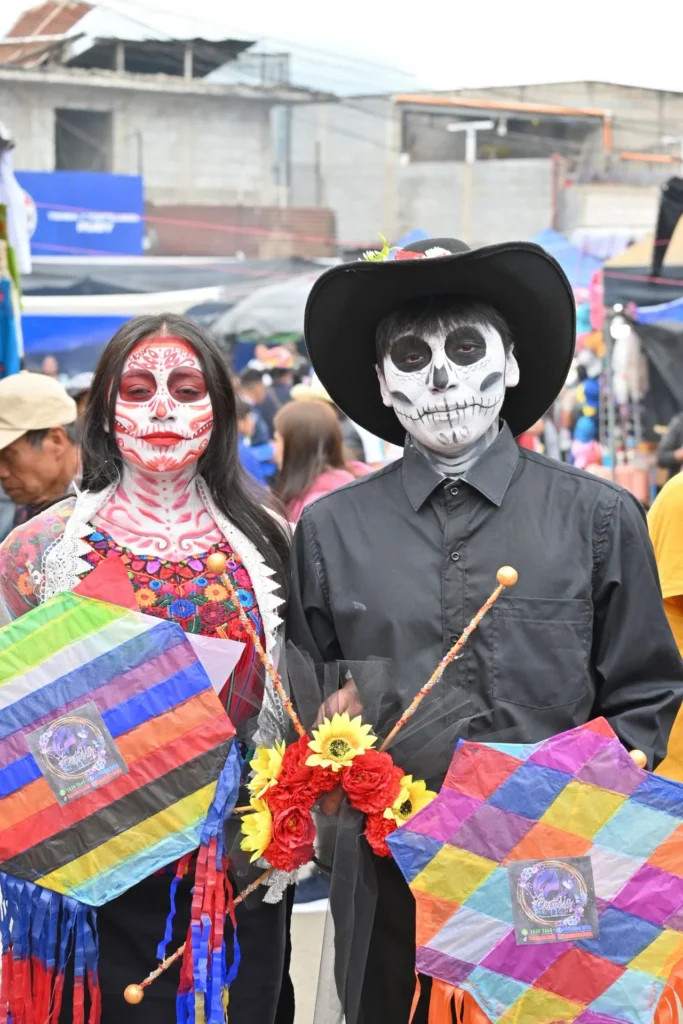
As well as the kite display, there are many other activities centred around it. In this regard, music plays throughout the day at the complex, with the marimba clearly taking centre stage. There are even traditional dances performed around the field, with the dancers wearing colourful masks and costumes steeped in history.
Discovering the local cuisine
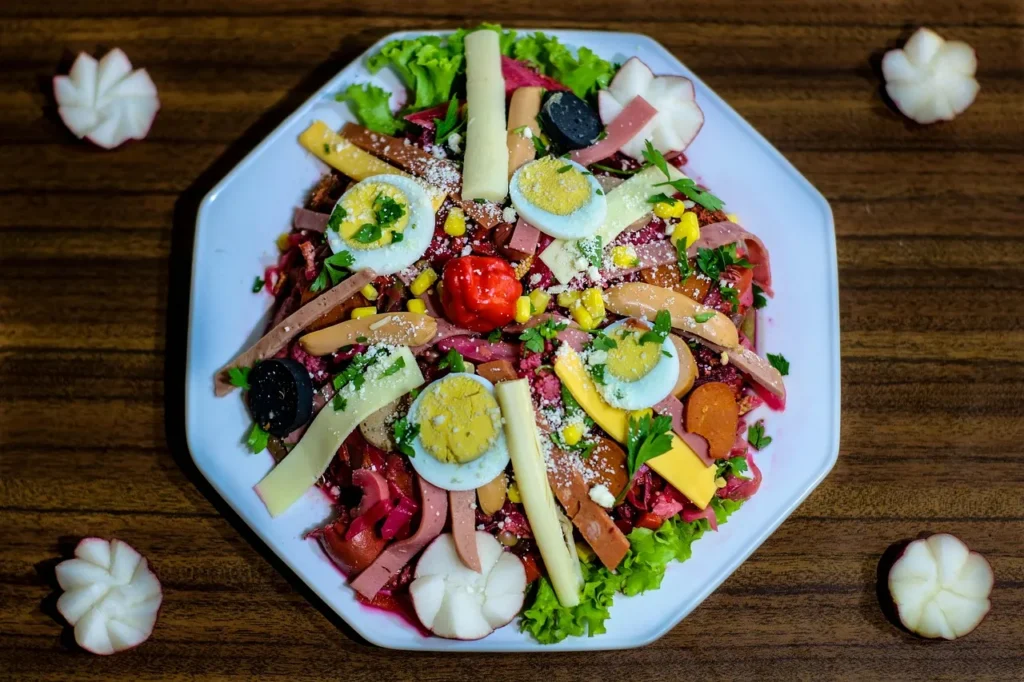
Fiambre is the undisputed star dish of All Saints’ Day in Guatemala. It's a cold salad made with a wide variety of ingredients, ranging from cold cuts and meats to vegetables and cheeses. There are also traditional sweets specific to this festival, such as buñuelos, jocotes in honey and sweetened squash. You’re sure to be able to try many of them at the street food stalls set up in Sumpango. As for drinks, corn atol and white atol are traditional choices.
Take part in community celebrations
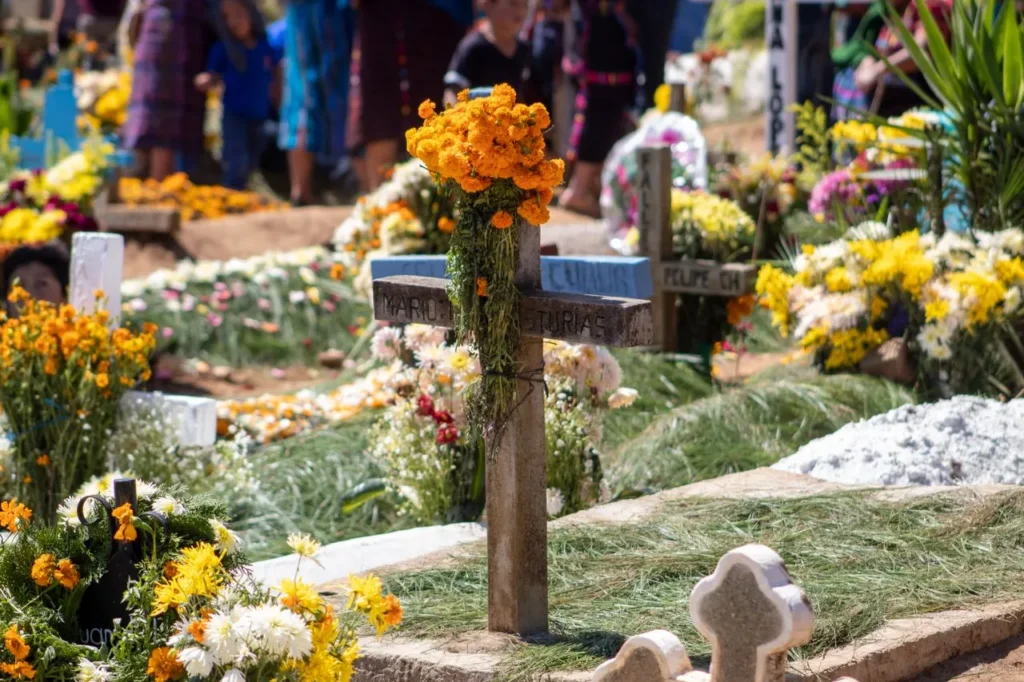
If you want to feel more connected to the locals, one of the things I’d recommend doing is visiting the cemetery near the football ground to watch the rituals (which take place early in the morning) and see how families clean and decorate the graves of their loved ones.
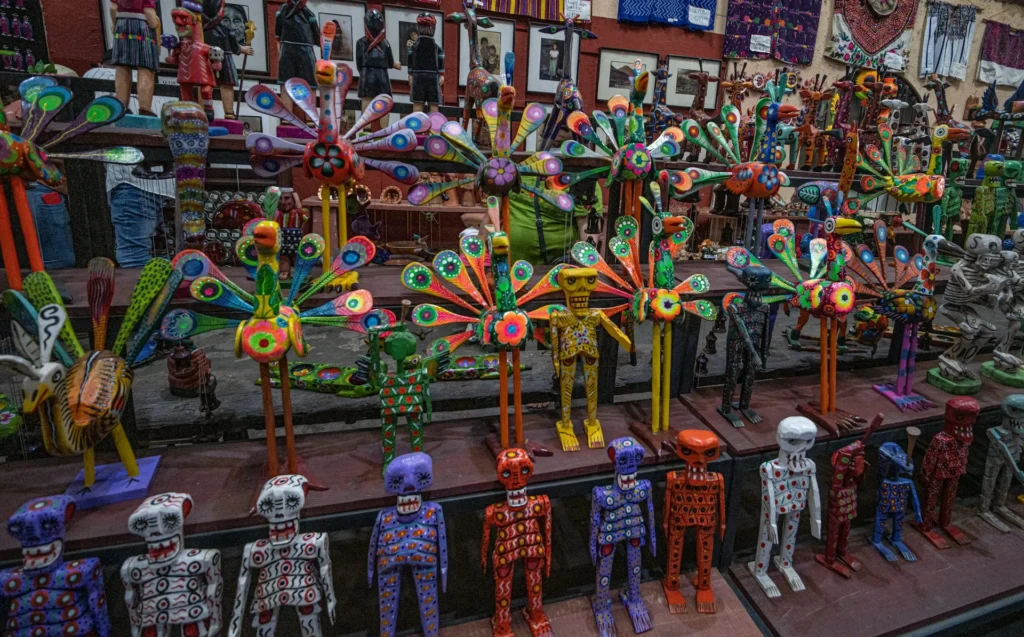
What’s more, as a gesture of respect and to support the festivities, I’d also encourage you to pop along to the small craft markets organised as part of the event. You’re sure to find a souvenir that will remind you of this day forever.
Sumpango Festival vs. Santiago Sacatepéquez Kite Festival
Key differences between the two festivals
Both festivals take place within the same department and share the same spiritual roots, as well as the same technique of using rice paper. However, they offer a somewhat different kind of celebration. Whilst the Sumpango festival is held on a large, open football pitch, the Santiago festival takes place within the town’s cemetery.
The Sumpango festival is, of course, much better known and attracts far larger crowds, as it has evolved into a major event which also features concerts and even a kite-flying competition. In short, it focuses more on entertainment and attracting tourists. The festival in Santiago Sacatepéquez is much more intimate and traditional, with smaller kites, partly due to the physical limitations of the cemetery grounds.
Which one to visit, depending on your interests
The one in Sumpango is much more popular, and tourists tend to head there to experience the Day of the Dead in Guatemala. What’s more, the kites can be seen more clearly there and are more impressive due to their size. Furthermore, there is more infrastructure in place to accommodate all the visitors. The festival in Santiago, on the other hand, whilst less spectacular, is more awe-inspiring and allows you to get closer to the original Mayan legend that gave rise to the festival. However, the space is more limited and the crowds are harder to manage.
Which one you choose will depend on your travel plans and personal preferences. And although the two towns are very close to each other, I wouldn’t recommend visiting both, as there’ll be heavy traffic between them whenever you try to do so.
- We invite you to read our article about the Jocotenango Fair.
Tips for visiting the Sumpango Giant Kite Festival
What to bring on the day of the festival
- Closed, comfortable footwear.
- Sun cream, sunglasses and a cap.
- A handkerchief to cover one’s mouth and nose from the dust in the countryside.
- A light jacket to see you through the early hours of the morning.
- Cash.
- Backpack worn on the front for safety.
Tips for taking photographs
If you visit cemeteries and wish to take photographs to capture the mystical atmosphere, please ask the relatives for permission first, whether you are taking a photograph of them or of the graves of their deceased loved ones. Don’t forget that this is a moment of spiritual intimacy.
Where to stay near Sumpango
Sumpango is a small village with limited accommodation options. For this reason, it's best to stay in Antigua Guatemala, which is just 30 minutes away. Furthermore, it's the city with the widest range of accommodation options in the whole country, offering a great variety to suit all budgets. Of course, another option is to stay in Guatemala City.