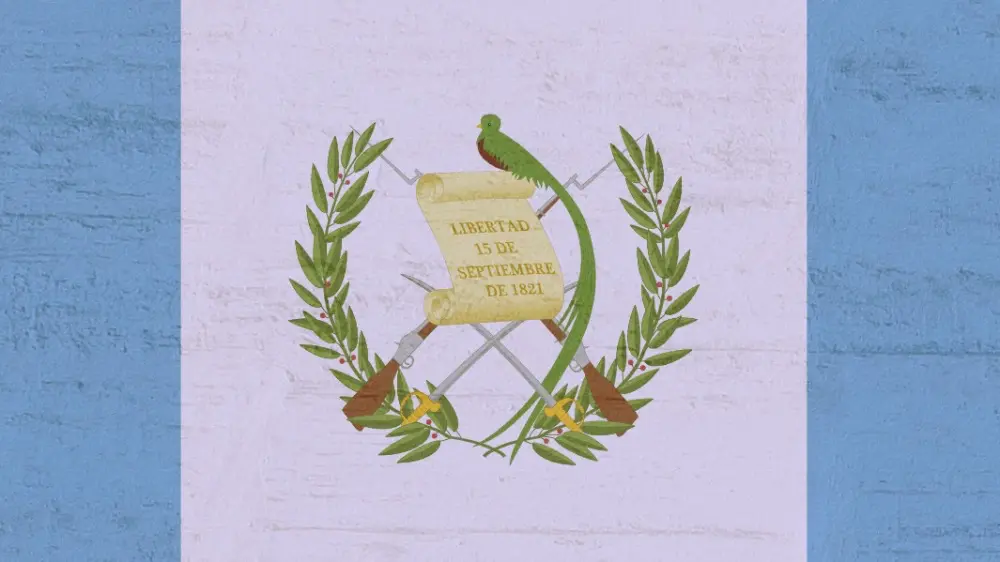
Guatemala’s coat of arms deserves closer examination, as it may reveal something more about the country’s identity and character. Obviously, the coat of arms, the flag and the national anthem constitute the national symbols with which the Guatemalan state identifies itself. From a heraldic perspective, however, it conveys a visual message of freedom and justice: the elements that make up the coat of arms actually tell the story of Guatemala, which did not become an independent nation until the 19th century.
Thus, the quetzal takes centre stage on the coat of arms as a symbol of freedom, alongside the scroll bearing the date of independence; the rifles, which allude to the determination to defend the rights of Guatemalans; the crossed swords, which symbolise honour and justice; and the laurel wreath, which celebrates victory and peace.
- We invite you to read our article about Guatemalan coffee.
The history of the Guatemalan coat of arms
Guatemala’s official coat of arms has been in use for over a century and a half. It dates back to 18 November 1871, when it was officially adopted during the government of General Miguel García Granados, as part of the liberal reforms.
The Swiss artist Juan Bautista Frener, then director of the Guatemalan Mint, designed the coat of arms. Frener had previously been responsible for the distinctive designs and reliefs on the national currency. In this new work, he drew on all his technical expertise to create an image intended to embody national values.

The elements of the coat of arms
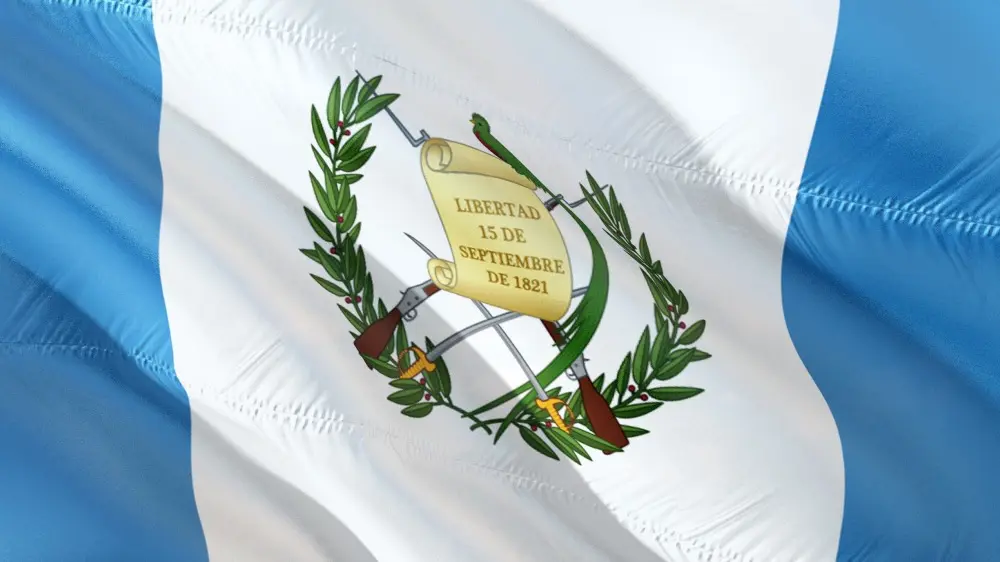
The coat of arms of Guatemala consists of five main elements, each with its own meaning rooted in tradition and defined by national law.
The quetzal
The quetzal is the most important symbol on the coat of arms. At the top, perched on the scroll, is Guatemala’s national bird, depicted in a naturalistic style. The quetzal embodies the nation’s ideals of freedom, independence and autonomy. On the coat of arms, the quetzal faces to its left, with its wings slightly outstretched, in a dominant position that encompasses and gives meaning to the entire composition.
The fact is that, in Mayan culture, the quetzal was already regarded as a sacred bird, endowed with great spiritual power. It is a bird that can only live in the wild: in captivity, it dies of sorrow. A true metaphor for Guatemala’s path to independence.
The parchment
In the centre of the coat of arms, beneath the quetzal, is a rolled-up scroll bearing the inscription: ‘Liberty, 15 September 1821’. That is to say, the date of Guatemala’s declaration of independence from the Spanish Crown.
The parchment, depicted with all the characteristics of ancient paper, keeps the nation’s institutional origins alive. It carries all the weight of a historical document: Guatemala’s founding charter.
Rifles
At the bottom of the scroll, on either side, are two crossed rifles. These are Remington rifles, the predominant weapon during the liberal revolution of 1871. They demonstrate the Guatemalan people’s determination to protect their sovereignty: they symbolise war as an act of defence rather than an act of aggression.
The Remington model, on the other hand, reflects the historical context of independence, which was declared in the midst of the country’s liberal reform.
Swords
Behind the rifles, two crossed swords in the shape of an ‘X’ appear on the coat of arms. These two unsheathed golden swords represent the authority of the state and the defence of national honour. Their golden colour reinforces their ceremonial and symbolic nature.
The laurel wreath
A wreath of laurel branches frames the entire design at the bottom of the coat of arms. The laurel is a classic symbol of victory in Greco-Roman tradition. On Guatemala’s coat of arms, it also represents peace. This victory is none other than the attainment of independence. Peace: the harmony to which the nation aspires.
This structure, taken as a whole, is not merely aesthetic: it is a visual representation of a system of values. Each element has a defined place and a clear meaning, and together they form a coherent message about what Guatemala aspires to be and represent: a free, sovereign, just and peaceful nation.
Juan Bautista Frener, the artist behind Guatemala’s coat of arms
Juan Bautista Frener was one of those unassuming yet pivotal figures in the symbolic construction of a country. In this case, Guatemala. Born in Lucerne, Switzerland, in 1821, he arrived in what would become his adopted homeland whilst still in the 19th century, leaving a mark that remains evident in the national identity to this day.
Frener was appointed in 1853 to work at the Royal Mint. His main craft was engraving, which he mastered with great precision. Over time, his name even came to be associated with a new systematic approach to teaching the discipline in which he excelled, particularly in metal engraving.
Frener’s significance was not limited to the design of the national coat of arms. He was an active promoter of cultural initiatives, including a proposal for an academy of painting, printmaking and sculpture, which was approved in 1883. He died in Guatemala in 1892, after almost four decades of intense work in the country. Today, his name remains linked to Guatemala’s official emblem.
Other coats of arms of Guatemala
The history of the national coat of arms goes far beyond its current design. Guatemala has had several official coats of arms since its independence, each reflecting the political context and the identity the country wished to project at that time.
First coat of arms: 1823–1842
The first coat of arms of the State of Guatemala dates from 1823 to 1842. This design represented the independence of Central America and featured five mountains, five volcanoes symbolising the five states of the Central American Federation. It also included a Phrygian cap (a symbol of liberty in the French revolutionary tradition), books and other elements reflecting the idea of a liberal and republican state.
This coat of arms was used during the early years of independence, when Guatemala was part of the Federal Republic of Central America. Its design was more complex and symbolic, featuring numerous elements that represented the idea of a federation rather than just a single state.
Coat of arms of 1851: Guatemala’s first official coat of arms
Guatemala’s first official coat of arms as an independent nation was adopted in 1851. This design was more understated and focused on national identity. At the time, it reflected the attempt to forge a distinct identity following the dissolution of the Central American Federation.
During this period, the country was seeking to establish itself as an independent state, without direct reference to the federation. The 1851 coat of arms was a step towards that goal, but it did not yet contain all the elements we recognise today.
Coat of arms of 1871: The current symbol
The current coat of arms was created against the backdrop of the liberal revolution of 1871, a movement that profoundly changed Guatemalan politics and brought General Miguel García Granados to power.
This coat of arms was officially adopted on 18 November 1871, by Executive Decree No. 33, during the administration of García Granados himself. Juan Bautista Frener’s work was not merely decorative: it was an attempt to create a symbol that would represent the nation’s identity and the country’s cohesion at a time of political transformation.
The coat of arms was adopted as part of the liberal reform, which sought to modernise the country, strengthen national sovereignty and create symbols that reflected a clear and contemporary identity. The 1871 coat of arms was part of that effort: an icon representing Guatemala’s freedom, autonomy and independence, featuring elements that could be understood by both the population and the wider world.
The coat of arms has been in use since 1871
Since 1871, the coat of arms of Guatemala has retained its basic design, with minor variations in colours and graphic details, but without any substantial changes to its structure or meaning. The fact that it has remained in use for over 150 years is unusual for national symbols and reflects the stability of the message conveyed by the coat of arms.
The current coat of arms, therefore, has been in use for over a century and a half and remains in use to this day. Its design is unmistakable and embodies national values that remain relevant: freedom, sovereignty, justice, honour, victory and peace.
The law sets out the meaning of each of the elements that make up the coat of arms, ensuring that its use and interpretation are consistent with the original intention. This prevents the coat of arms from being arbitrarily reinterpreted or its original meaning from being lost.
- We invite you to read our article about dances of Guatemala.
Where to find the coat of arms of Guatemala
The coat of arms of Guatemala is an official symbol used in various contexts, both institutional and popular.
An interesting fact is that an original-scale model of Guatemala’s national coat of arms is on display in the Banquet Hall of the National Palace of Culture. This model is a faithful reproduction of the coat of arms, serving as a reference for its official use, as well as a decorative feature of historical significance.
The use of the coat of arms is governed by law and by the internal regulations of state bodies. This prevents it from being used in inappropriate contexts or losing its meaning. Any official use must adhere to the original design. However – and this is not always the case in other countries – the symbol is also widely used in popular culture, in the arts, in cultural contexts and even during celebrations.
- We invite you to read our article about the Santa Catalina Arch.
Institutional and government use
In the institutional sphere, the coat of arms appears on:
- Official government documents: laws, decrees, resolutions, public contracts.
- Government buildings: palaces, ministries, public offices.
- Official vehicles: cars, patrol cars, aircraft and government vessels.
- Uniforms and insignia of public institutions: the armed forces, the police and law enforcement agencies.
In these contexts, the coat of arms serves as a symbol of authority and as an indication that the document or space belongs to the State. Its presence signifies official status and legitimacy.
Use in education
In the field of education, the coat of arms is a central feature in schools and colleges. It is displayed in:
- Boundaries of educational premises.
- Flags and pennants.
- School walls and corridors.
- School ceremonies, particularly on national holidays.
Use at formal ceremonies
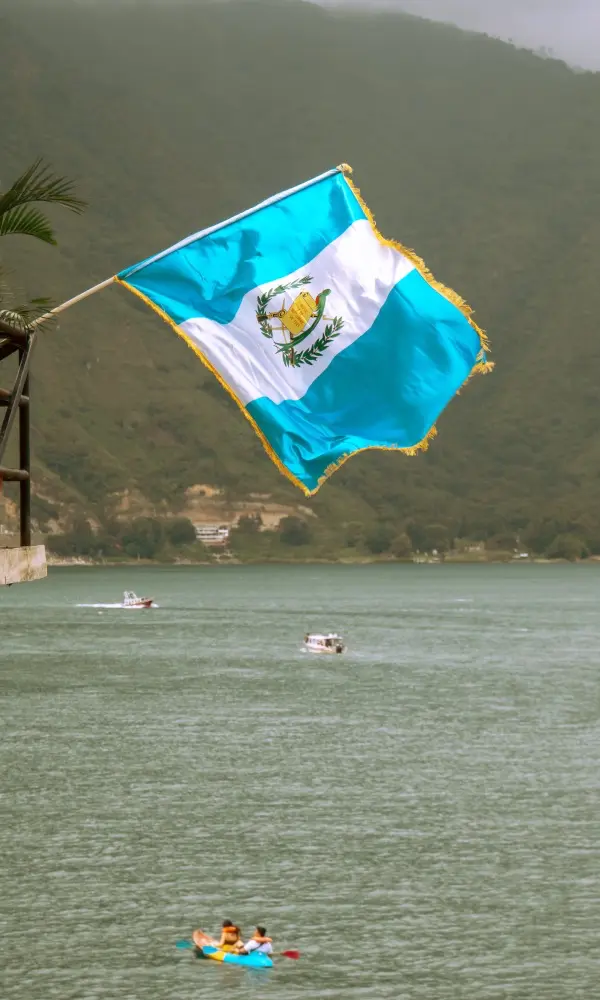
At formal ceremonies, such as on 15 September (Independence Day) or 30 June (Armed Forces Day), the coat of arms is displayed alongside the flag and is accompanied by the reading of texts about national symbols.
Use in civil and commercial documents
The coat of arms also appears in:
- Passports and identity documents.
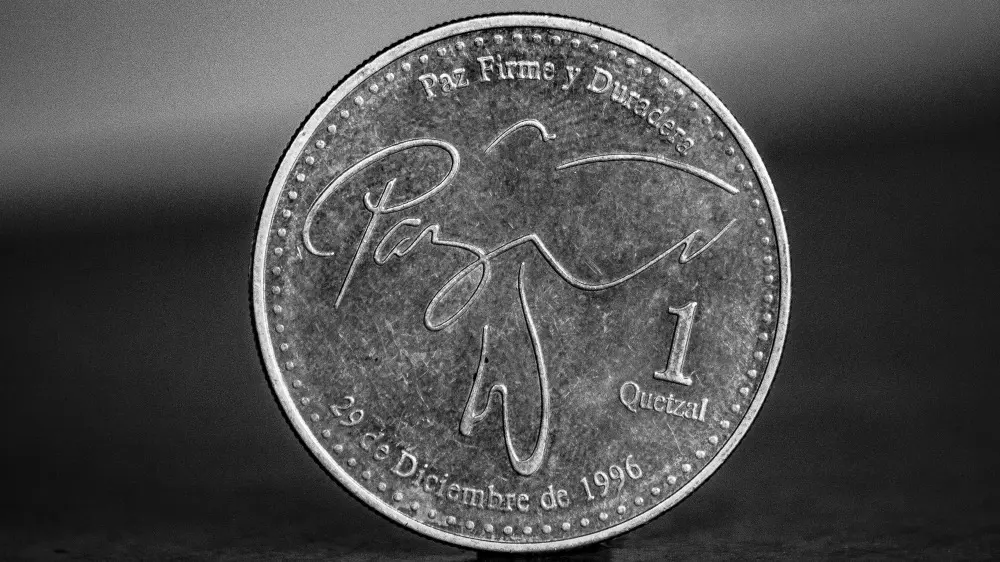
- Banknotes and coins.
- Official stamps and seals.
- Goods that aim to highlight their Guatemalan origin.
In such cases, the coat of arms serves as a symbol of national identity. When a product bears the coat of arms, it is indicating that it is Guatemalan, that it belongs to the nation.
Use in culture and the arts
In culture, the coat of arms is used in:
- Works of art that represent national identity.
- Illustrations, engravings and graphic designs.
- Patriotic-themed clothing and accessories.
- Cultural events and festivals.
- We invite you to read our article about the Popol Vuh Museum.
The coat of arms has become an artistic and cultural motif, reproduced in various formats and styles. In these contexts, it is used more freely, but always with respect for its meaning.
Frequently Asked Questions about the coat of arms of Guatemala
When was the current coat of arms adopted?
The current coat of arms was adopted on 18 November 1871, by Executive Decree No. 33, during the administration of General Miguel García Granados.
What is the difference between the current coat of arms and previous designs?
The current coat of arms is more understated and focused on national identity. Earlier designs, such as that from 1823–1842, were more complex and symbolic, featuring multiple elements representing the idea of a federation. The 1851 coat of arms was a step towards defining a distinct identity, but it did not contain all the elements we recognise today.
Why is the coat of arms important to Guatemalan identity?
The coat of arms is important because it represents the highest values of Guatemalan nationhood. Each element conveys fundamental values such as freedom, courage and peace, reminding all Guatemalans of their commitment to defending their sovereignty and identity.