The Guatemalan flag and its most intriguing coat of arms are much more than just national symbols; they are elements steeped in history that indirectly tell the story of the country, its indomitable spirit, its untamed nature and its yearning for freedom. By learning about and analysing each element of this interesting flag, we can gain a much better understanding of the past and present of this fascinating Central American country.
If you’re a curious traveller planning a trip to Guatemala soon, stick with us. By taking a closer look at the country’s flag, we’ll reveal the fascinating stories it holds.
What does the Guatemalan flag look like?
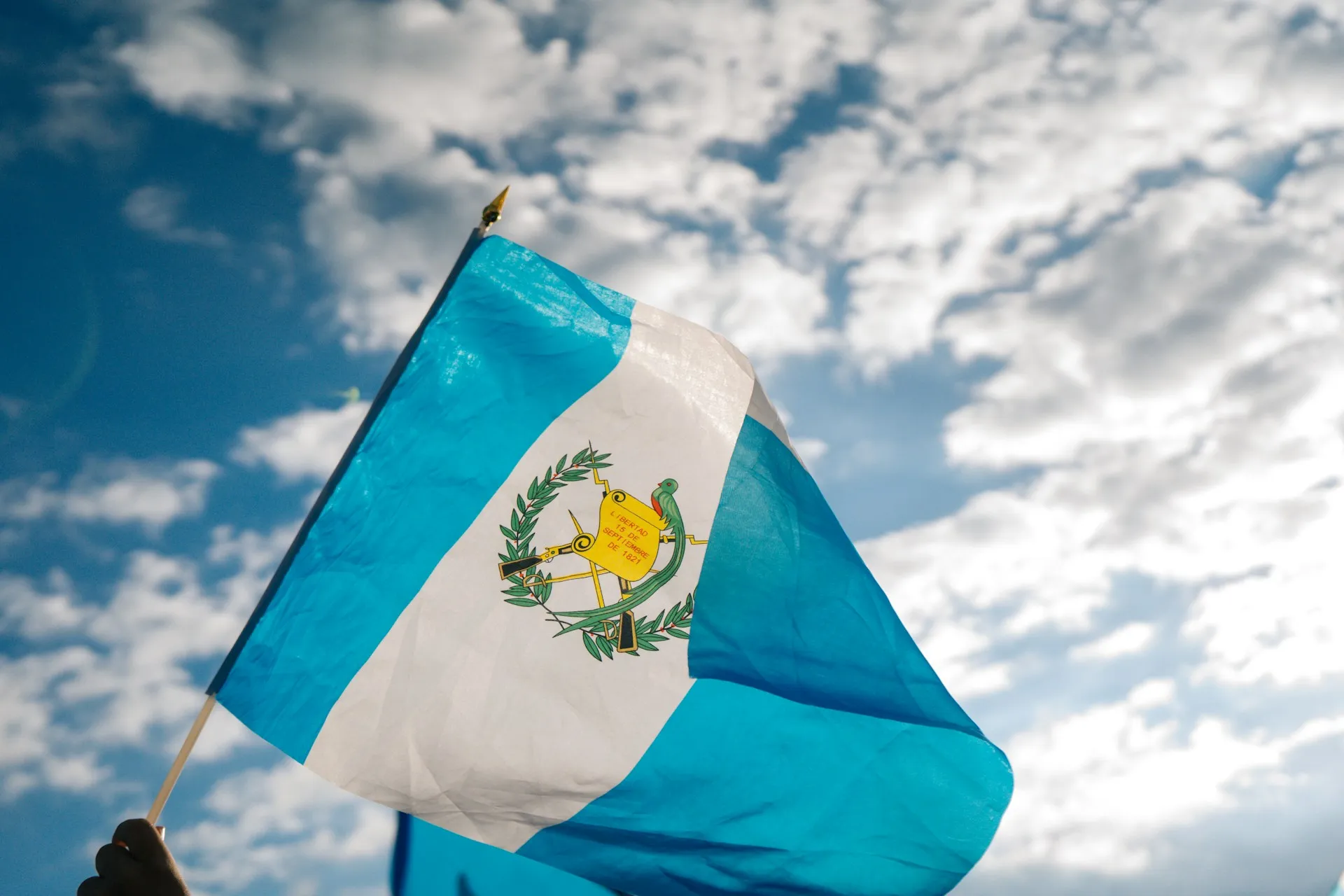
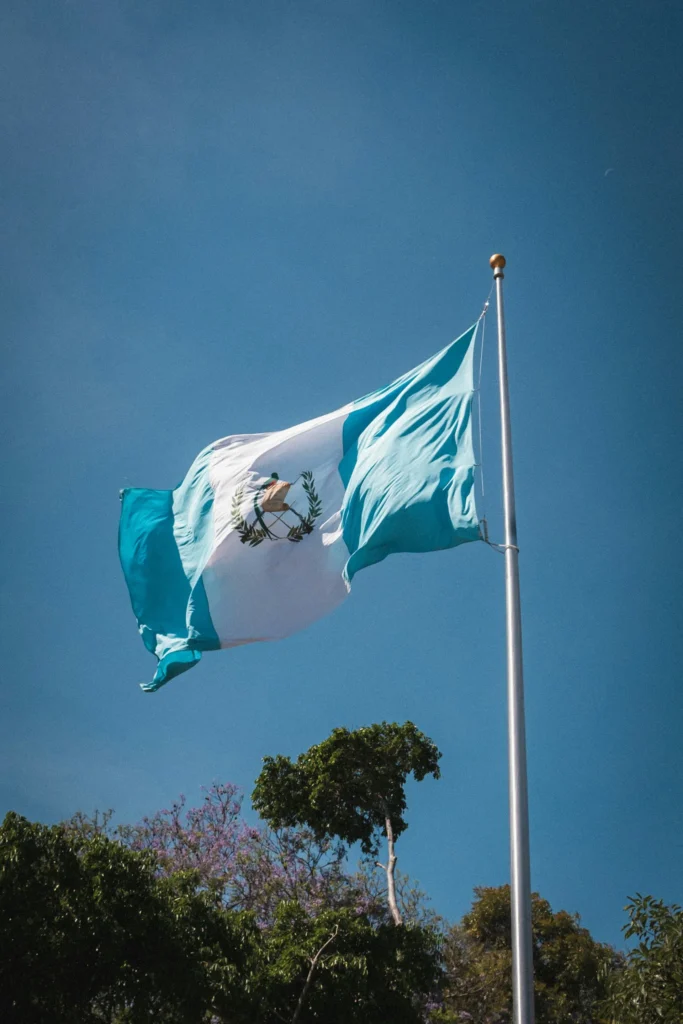
The first thing that catches the eye about the Guatemalan flag is not its colours, but its coat of arms. But let’s take it one step at a time. First of all, it's a flag consisting of three vertical stripes of equal size, in the colours blue, white and blue. This vertical arrangement was officially adopted in 1871 by decree of President Miguel García Granados, thus breaking with previous designs and seeking to achieve an aesthetic that would draw inspiration from the ideals of freedom embodied in the French flag.
The two outer stripes are sky blue, whilst the central stripe is white. It's on this central stripe that we find Guatemala’s fascinating national coat of arms, which has a great deal to say. The most striking feature is the quetzal, the country’s official bird, perched on a scroll bearing the date of independence. We also see two Remington rifles and two swords, both crossed over one another. And the whole design is encircled by a laurel branch.

These three elements (the rifles, the swords and the laurel) form part of Guatemala’s coat of arms, and each carries its own significance. The rifles, for one thing, are based on the design of the models used during the Liberal Revolution of 1871; they symbolise strength, the defence of sovereignty, freedom and the protection of Guatemala’s interests. They signify that the country will defend itself if necessary against external or internal aggression.
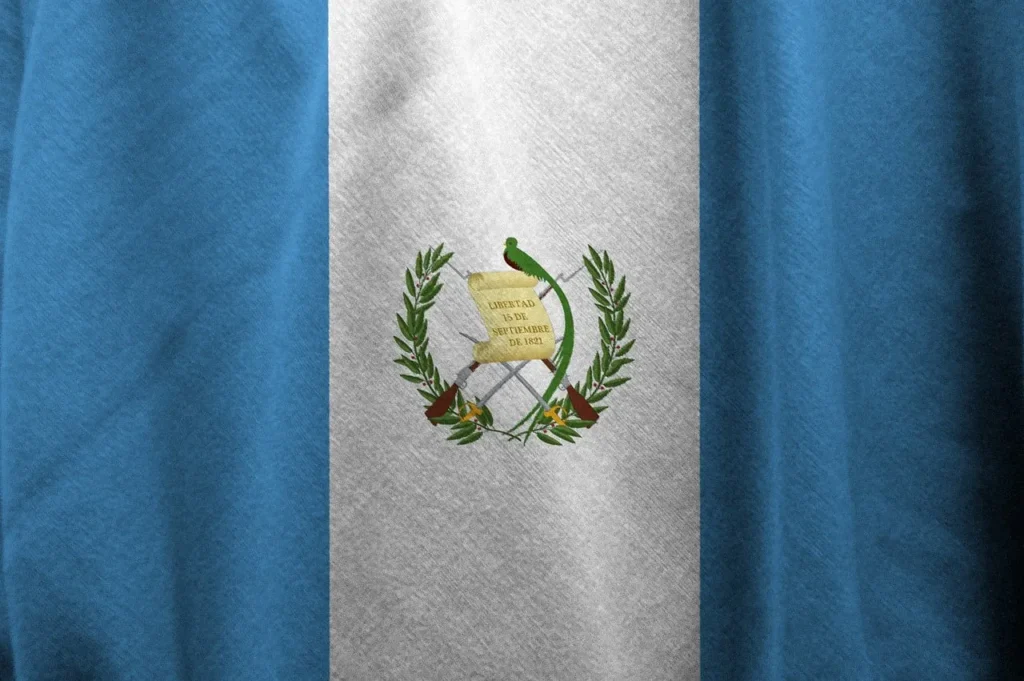
The swords symbolise honour and justice, serving as a reminder of the moral values that should guide the country’s leaders and citizens. Finally, the laurel branches, inspired by classical Greco-Roman culture, represent victory and glory following the struggle for freedom. However, in the Guatemalan context, they also allude to peace, reminding us that the country favours harmony and dialogue over armed conflict. For this reason, these branches shelter the weapons, implying that the primary aim is to avoid violence.
- We invite you to read our article about the flora of Guatemala.
History of the Guatemalan flag
The flag we see flying today in Guatemala, which represents the country, did not always look like this. Throughout its history, the country has had six different flag designs before arriving at the current one, with each design reflecting its historical moments. In this section, we take a look at its history up to the present day.
The origins of the Central American Federation
Guatemala’s heraldic history formally began following independence from Spain and Mexico in 1823 (as, for a brief period after independence from the Iberian Peninsula, the country fell under the rule of the Mexican Empire). Following this separation from both countries, the so-called United Provinces of Central America (later known as the Federal Republic of Central America) were established, a federation of which Guatemala formed a fundamental part as one of the member states.
The flag adopted by this federation (with two blue stripes at either end and a white one in the middle) would later form the basis for the final design of the flag of the Republic of Guatemala. In fact, following the dissolution of this federation, Guatemala retained these colours, but the conservative governments of the nineteenth century introduced horizontal red and yellow stripes (the colours of the Spanish flag) to reflect their roots and their colonial political leanings.
The creation of the current flag in 1871
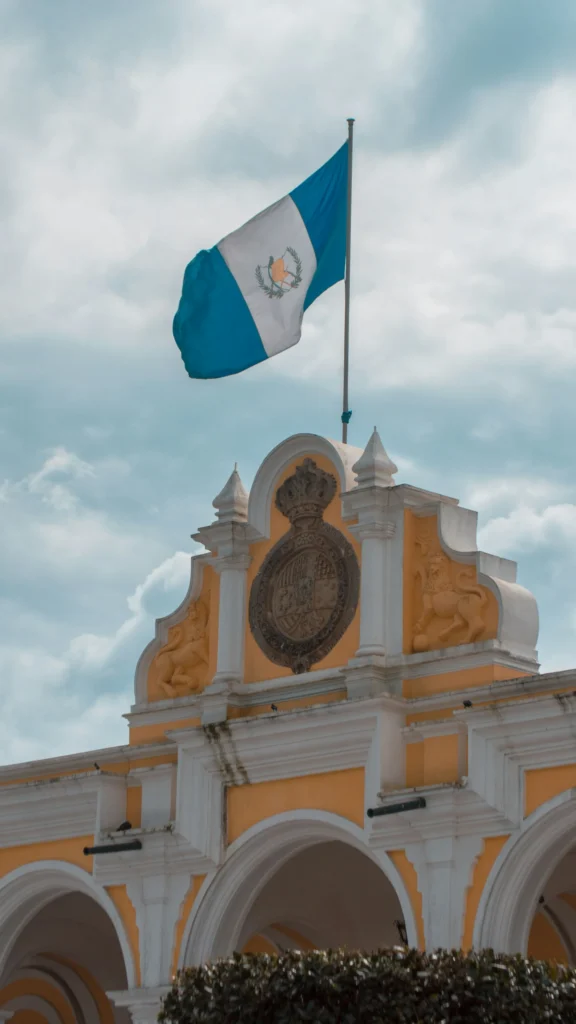
Guatemala’s current flag, as we know it, was officially adopted on 17 August 1871, and is linked to a radical change in the country’s history: the Liberal Reform. The authorities that emerged following the triumph of the Liberal Revolution that year (the political and military movement that overthrew the conservative president appointed by the previous dictator) sought to make a clean break with that conservative outlook, removing any reference to the Spanish colonial era from the flag.
In addition to that, the new design was also intended to set the country apart heraldically from the other Central American nations (which featured horizontal stripes).
Official regulations governing the flag
The Guatemalan flag has remained unchanged since 1871, but a series of strict regulations have been issued to standardise its use and prevent distortions. For example, the exact shade of sky blue it must be, as well as the dimensions of each stripe, have been specified. The type of fabric to be used for official flags and the size of the coat of arms have also been laid down, and alterations to the flag for commercial purposes have even been prohibited.
- We invite you to read our article about the traditional dress of Chichicastenango.
What do the colours of the Guatemalan flag mean?
The meaning of sky blue
The sky-blue colour at both ends of the Guatemalan flag represents the highest ideals that the Guatemalan State seeks to uphold: justice, loyalty and strength. But it also refers to the country’s own territory, which is so precious to its citizens. In this sense, the blue also symbolises the two oceans (the Atlantic and the Pacific) that flank both Central America and the country itself, as well as the clear, pure skies that cover the national territory.
The meaning of the colour white
The white in the centre of the flag is very pure and intense. It was chosen to represent the light and the civic virtues of the Guatemalan Republic, such as peace, integrity and national unity. With regard to the latter, the white colour symbolises the cohesion between the different peoples and cultures living together in the country.
Guatemala’s Flag Day
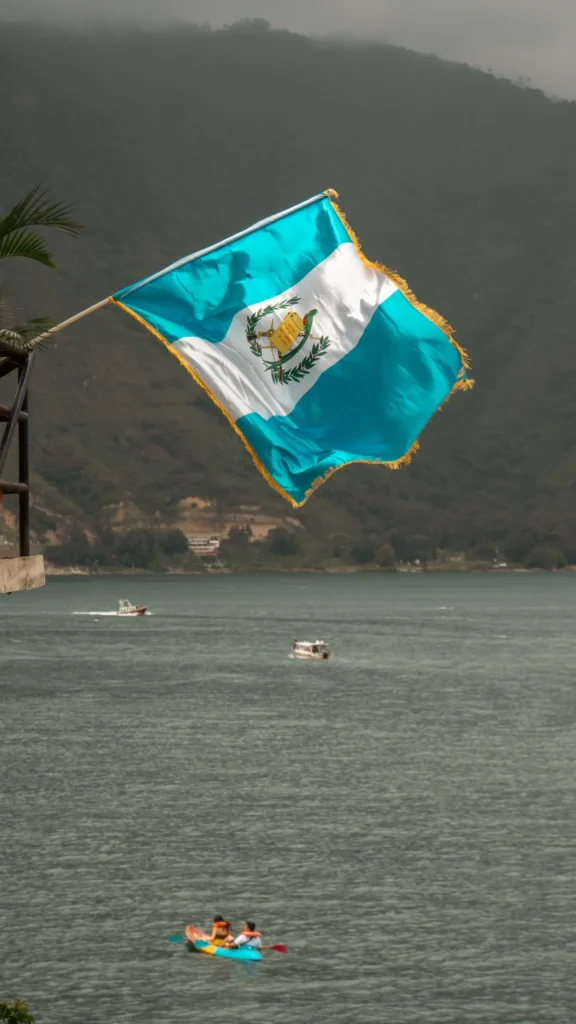
In honour of the day on which Guatemala’s new flag was officially adopted, National Flag Day is celebrated on 17 August every year. It's a day of national pride when schools, institutions and streets across the country are filled with parades and people carry the official flag.
- We invite you to read our article about traditional Guatemalan dishes.
Interesting facts about the Guatemalan flag
It’s one of the few flags in the Americas with vertical stripes
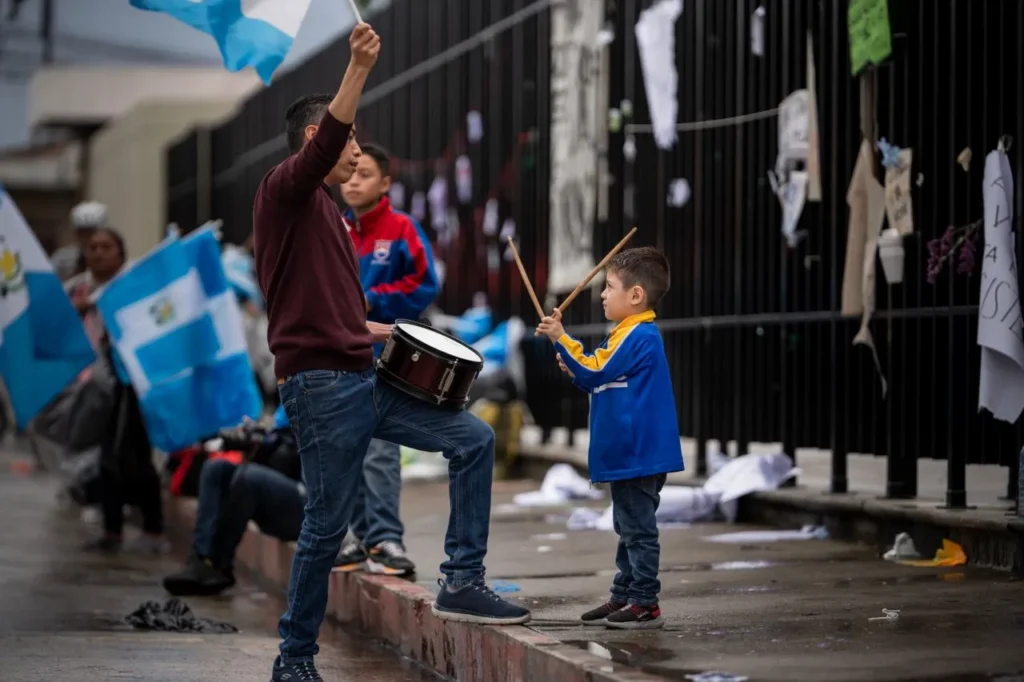
Guatemala not only has one of the few flags in Central America with vertical stripes, but it's also one of the few across the whole of the Americas to follow this pattern. The vast majority of countries on the continent have opted for horizontal stripes, but Guatemala, as we have mentioned, wanted to set itself apart from the rest whilst paying tribute to the ideals of liberty of the French Revolution.
It uses the traditional colours of Central America
Despite the change in the orientation of its stripes, the Guatemalan flag continues to feature and retain the historic colours of Central America – the same colours as those of the flag of the United Provinces of Central America. However, of all these countries, Guatemala is the one with the softest and brightest shade of blue.
The quetzal appears as a symbol of freedom
The quetzal bird is the part of the Guatemalan flag that people tend to like the most. It symbolises freedom, as this bird has been considered sacred since the time of the Maya civilisation. Furthermore, legend has it that the quetzal is incapable of living in captivity, dying of sadness if confined to a cage. As such, the quetzal is used on the flag to symbolise the country’s eternal sovereignty.
Guatemala is one of the few countries whose flag features rifles on the national coat of arms
Yes, the Guatemalan flag is one of the few in the world to feature actual firearms on its coat of arms and national emblem. Mozambique, Bolivia and Haiti are the other three countries that do so. In Guatemala’s case, they represent the country’s unwavering determination to defend its homeland by force if strictly necessary. However, as we have already mentioned, the weapons are wrapped in laurel leaves as a symbol to convey that peace will always be preferred.
- We invite you to read our article about the birds of Guatemala.
Frequently Asked Questions about the Guatemalan flag
Who designed the Guatemalan flag?
It was created during the term of office of Miguel García Granados, when all its elements were also established. However, the coat of arms was designed by the Swiss artist and engraver Juan Bautista Frener, who devised the heraldic composition. The result was very well received and, months after the colours and vertical design were officially adopted, the coat of arms was also officially adopted.
When was the current flag adopted?
Guatemala’s current flag was formally adopted on 17 August 1871.