Holy Week in Antigua Guatemala is not just another festival; it's one of the greatest displays of devotion on the planet. For days on end, the streets of this colonial city are transformed into a scene brimming with colour and mysticism, where processions and multicoloured carpets take centre stage. This festival is so important to Guatemala and its culture that it has been recognized as Intangible Cultural Heritage of Humanity.
In this short guide, we’ll tell you about its history, its significance and how you can experience it as a tourist, so that it becomes one of the most unique travel experiences.
Why is Holy Week in Antigua Guatemala so famous?
Holy Week in Antigua Guatemala is regarded as one of the most awe-inspiring spiritual and cultural spectacles in the world. There, Holy Week is celebrated on a grand scale and the city is transformed into a living theatre of devotion that captivates everyone who comes to experience it.
One of Guatemala’s most important religious traditions
For Guatemalans, Holy Week is a testament to their deep-rooted national identity. And in Antigua Guatemala, in particular, it's experienced with a collective intensity that is unrivalled. Virtually the entire community throws itself into preparing for the event, which brings society much closer together. Furthermore, this devotion continues to be passed down from generation to generation.

Cultural recognition and international profile
As we have mentioned, Guatemala’s Holy Week is recognised by UNESCO as intangible cultural heritage. This has given it great international prestige and has put the city of Antigua (where the festivities are at their most spectacular and beautiful) on the world map as a cultural and spiritual destination of the highest order.
In terms of tourism, the festival boosts the country’s economy, as travellers, photographers and television networks from all over the world travel specifically to the colonial city to document the event or experience it first-hand. Indeed, its grandeur is undeniable, and the spectacle is unrivalled across the entire American continent.
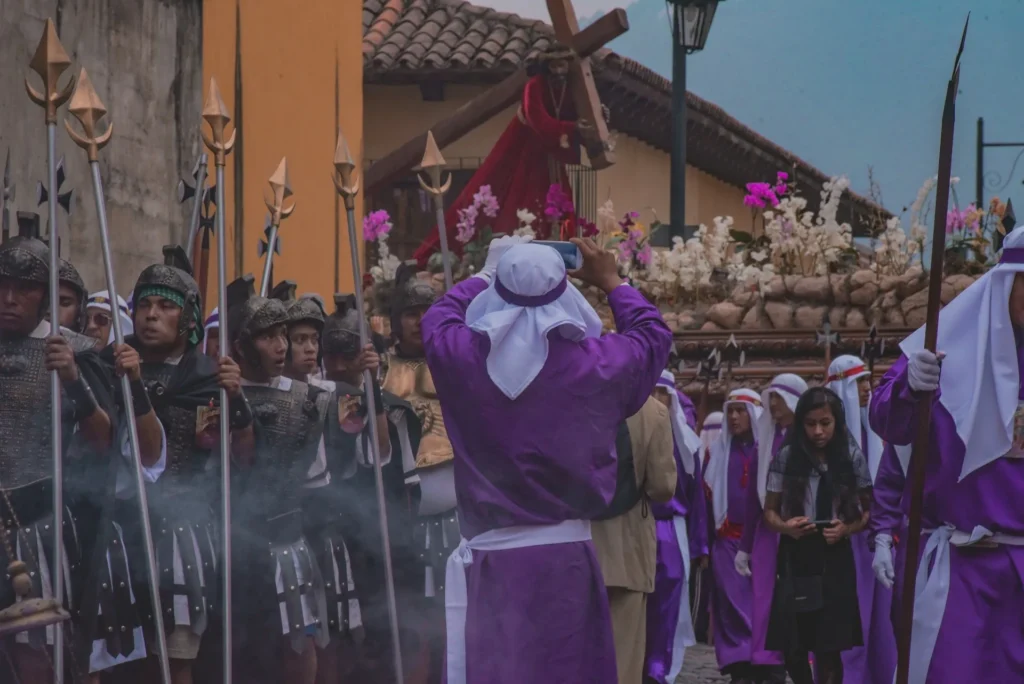
History of Holy Week in Antigua Guatemala
As you can imagine, Holy Week in Antigua Guatemala and throughout the country did not come about overnight. It's the result of a process of historical evolution and religious fusion spanning centuries.
The origins of the celebration in colonial times
The Holy Week celebrations were introduced to Guatemala in the 16th century following the Spanish conquest. Franciscan and Dominican missionaries and friars introduced these Catholic liturgical practices with the sole aim of educating and evangelising the local indigenous communities. In fact, according to records, the first documented Holy Week procession in Guatemala took place in that very century, specifically in the city of Antigua.
Over the following centuries, the 17th and 18th, the festival began to gain incredible momentum thanks to the founding of the cofradías and hermandades – civil and religious organisations that encouraged people from all walks of life to take part in the festivities.
The evolution of traditions over the centuries
As the centuries passed, Holy Week – introduced by the Spanish – began to undergo changes and ceased to be an exact replica of the processions held on the Iberian Peninsula. Consequently, local elements began to be incorporated, giving this religious festival a more distinctly Guatemalan character. In short, a new form of religious syncretism emerged, blending elements of Catholicism with aspects of the pre-Hispanic Mayan worldview.
This is how certain elements of Holy Week in Antigua Guatemala and other parts of the country come about – elements that we do not find in Spain, such as the carpets (which we will discuss later).
You should also be aware that Holy Week is not only celebrated in Antigua Guatemala, but is a festival observed throughout the country. However, this is the city where it's experienced most intensely and spectacularly. In Guatemala City, the country’s capital, the celebrations are also very vibrant because the capital of the kingdom, formerly located in Antigua, was moved here, and with it, the local customs.
UNESCO’s recognition
It was in 2022 that the UN officially declared Guatemala’s Holy Week to be Intangible Cultural Heritage of Humanity. The organisation considered this festival to be the symbol of national identity that most united the country. Thus, it was recognised not only for its beauty, but also for the unifying power it holds for Guatemala. In this way, the festival was further safeguarded, ensuring its legacy.
- We invite you to read our article about the Jocotenango Fair.
When is Holy Week celebrated in Antigua Guatemala?
Holy Week does not have a fixed date on the civil calendar, but it always falls between March and April. However, in Antigua Guatemala, the celebrations begin much earlier, with the rites of Lent.
Key dates and events during Holy Week
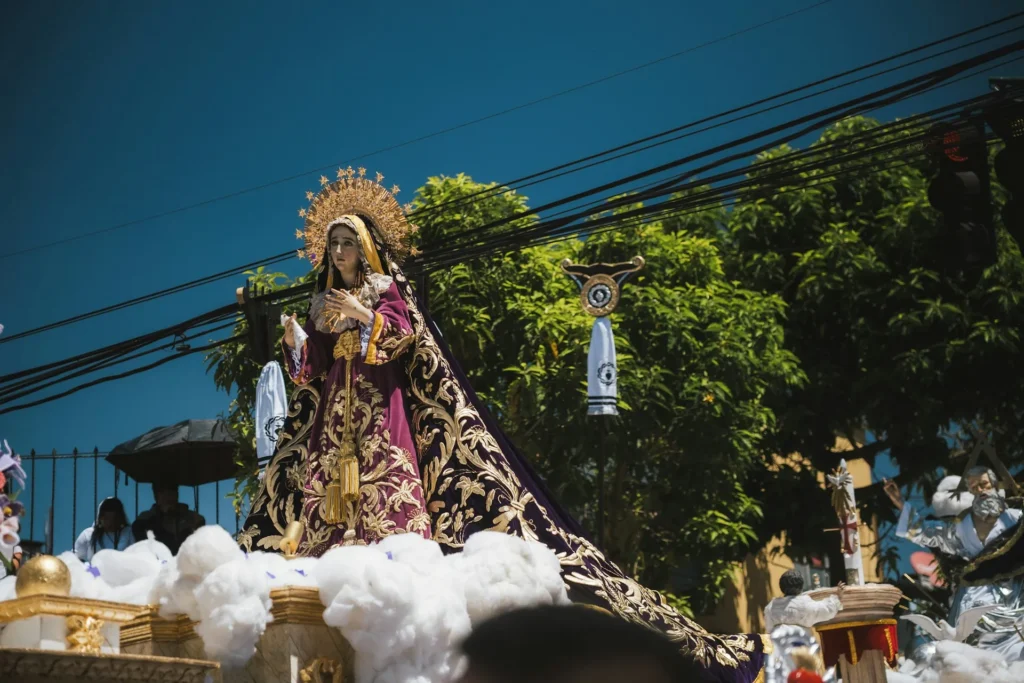
- Ash Wednesday: marks the start of Lent and usually takes place in February. From this day onwards, every Friday and Sunday in the following weeks, religious images are veiled inside the churches and the first processions take place in the nearby villages. In addition, on Sundays during Lent, an iconic procession is held in the historic centre of Antigua Guatemala.
- Fifth Sunday of Lent: this is the largest Lenten procession, during which the statue of Jesús Nazareno de la Caída is carried out of the Church of San Bartolomé Becerra and paraded for over 20 hours.
- Good Friday: marks the end of Lent, heralding the start of the most solemn celebrations. On this day, altars dedicated to the suffering of the Virgin Mary are set up in churches and homes. It's also a day when the youngest members of the community take centre stage, with children’s processions and displays of carpets made by children.
- Palm Sunday: marks the official start of Holy Week and is when the number of processions begins to double.
- Holy Wednesday: the procession of Jesús Nazareno del Milagro takes centre stage on this day and takes place on the outskirts of Antigua. It's one of the largest, most beloved and historic processions in the region.
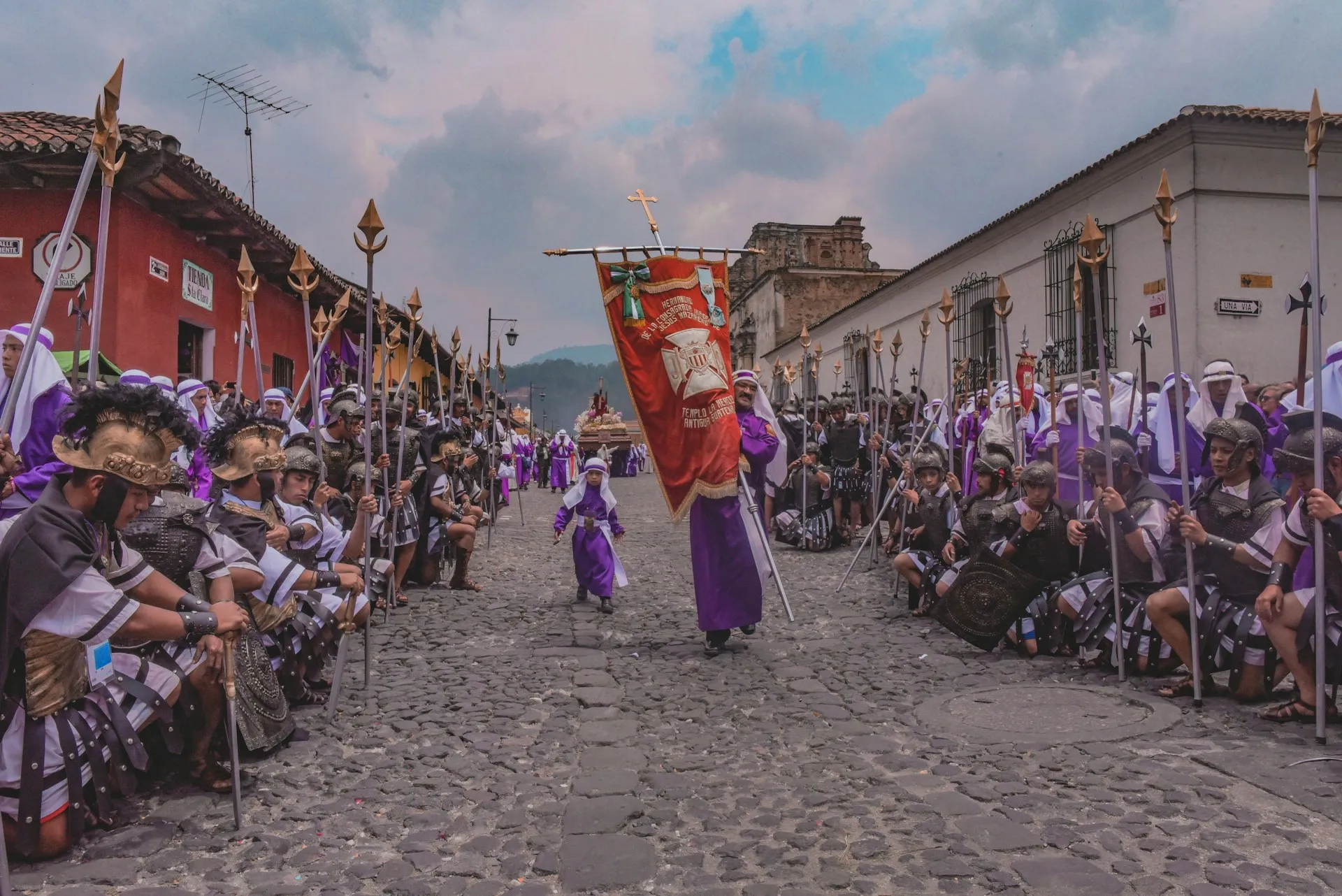
- Maundy Thursday: it’s the perfect day to admire the famous multicoloured sawdust carpets. To this end, the whole city is closed to traffic. In the afternoon, the impressive procession of Jesús Nazareno de los Milagros takes place and the streets are flooded with people wearing purple cones.
- Good Friday: this is the most solemn and moving day. Roman soldiers take to the streets and the historic procession of Jesús Nazareno de la Merced takes place, proceeding along the carpets. Afterwards, the purple hoods are replaced by strict mourning attire to make way for the Santo Entierro procession, which continues until the early hours of Saturday morning.
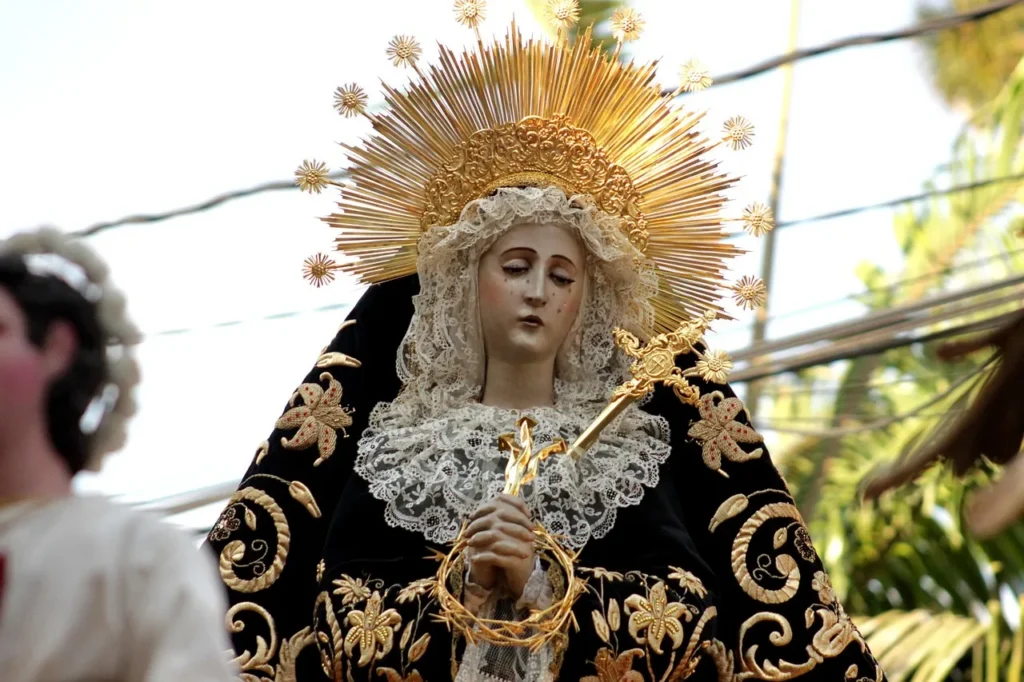
- Holy Saturday: a day of contemplation, silence and transition. The Virgin of Soledad takes centre stage on this day, with processions held in her honour in the afternoon.
- Easter Sunday: marks the end of Holy Week in Antigua Guatemala, and is the most joyful and colourful day of all. Fireworks are set off, there is festive music, and the bells ring out non-stop. Sadness, therefore, gives way to sheer joy. In the morning there are also processions, the most famous being that of the Church of San Pedro, and the carpets take on much brighter colours.
Key dates for visitors
As a traveller, there are three days during Holy Week in Antigua Guatemala that you simply mustn’t miss: Holy Wednesday, Holy Thursday and Good Friday. It's during this 72-hour period that the city’s greatest artistic, mystical and architectural splendour is on display.
The Holy Week carpets in Antigua Guatemala
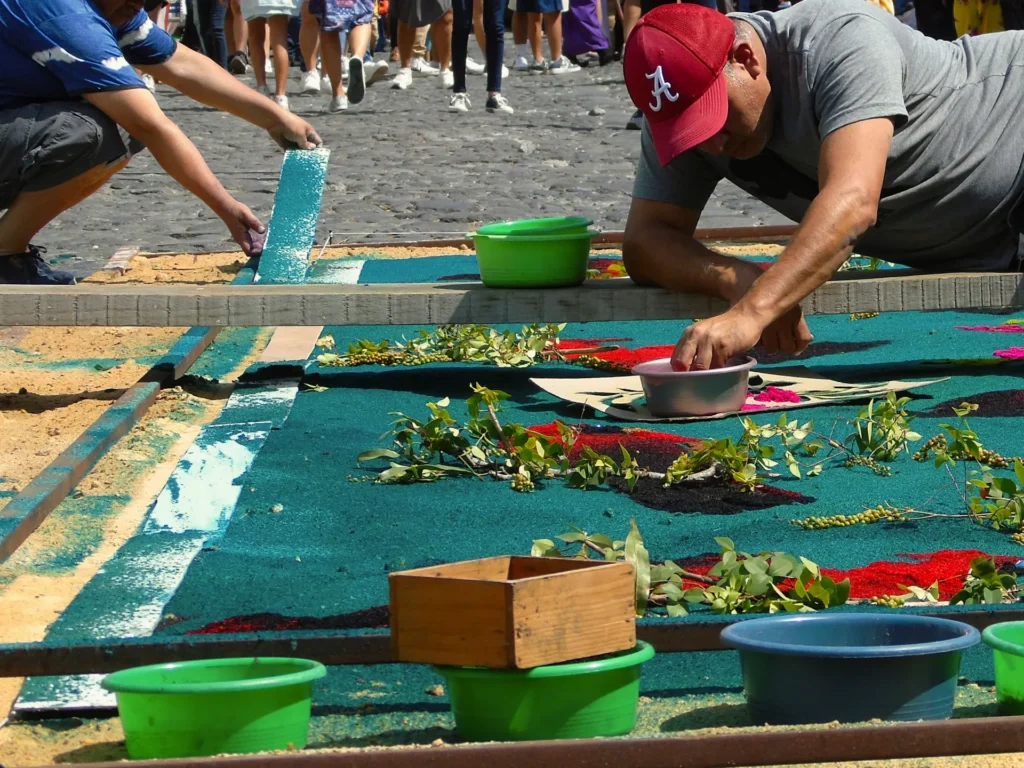
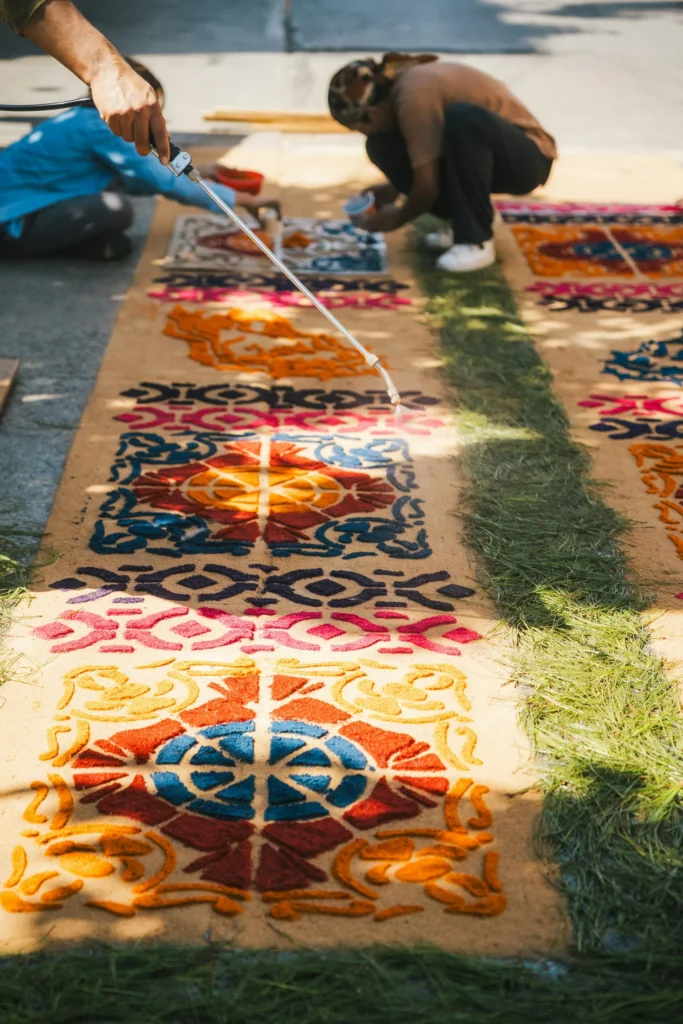
If there is one element that defines the visual identity of Holy Week in Antigua Guatemala, it is its spectacular temporary carpets. These are vast canvases of sawdust, flowers and fruit that bring true works of art to life on the ground, destined to vanish once the bearers of the processions have passed.
How traditional carpets are made
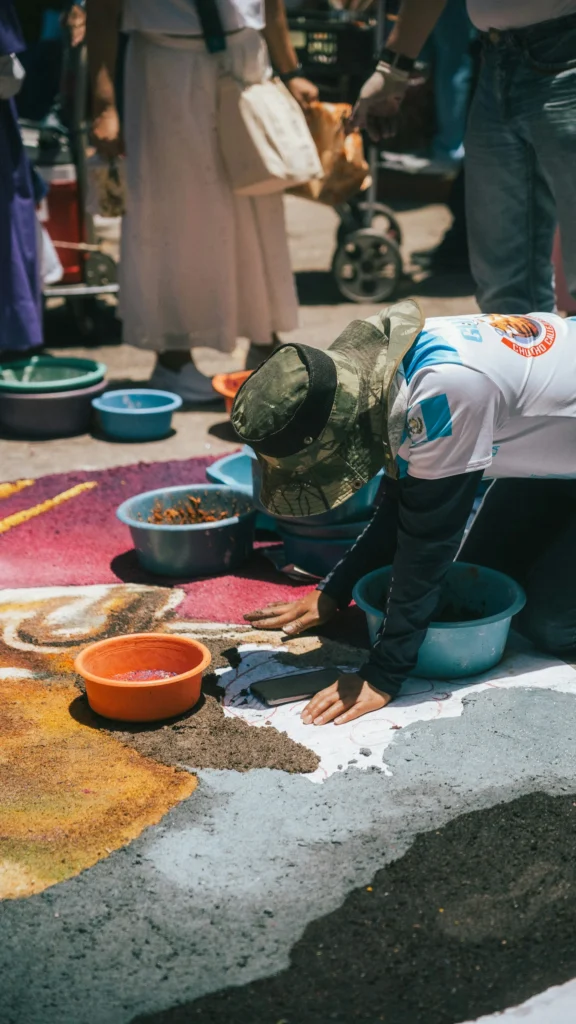
They are made collectively as part of a meticulous process that demands great physical stamina. They are usually made the night before or in the early hours of the morning before the procession, which is why whole families and groups of neighbours stay up all night.
First, the floor where the carpet is to be laid is cleaned, and a layer of undyed sawdust is spread to even out any unevenness in the stones and create a flat surface. Next, before proceeding, large stencils and moulds are placed on the ground and the pre-dyed sawdust is sprinkled over them. Finally, the canvas is decorated with flowers and fruit. Throughout the process, the creation is sprayed with a fine mist of water to prevent the wind or sun from damaging it.
Most commonly used materials, colours and designs
Sawdust is the main material used, and it's dyed using traditional methods. The most commonly used colours are purple, black, red, blue and bright green. As for botanical elements, petals, flowers, leaves and vegetables are usually used.
The designs range from intricate geometric figures and Baroque motifs to depictions of biblical landscapes and patterns inspired by traditional Mayan clothing.
The cultural significance of this tradition
For Guatemalans, designing a Holy Week carpet is an act of deep devotion, faith and gratitude. For the believer, seeing the image of Jesus and the Virgin Mary walking across the carpet they have created is a source of great pride.
Traditional seasonal cuisine
Cod à la Vizcaína is the star dish of this season. It's a recipe of Spanish origin, as you might imagine, but it has been adapted and seasoned with local ingredients. Other typical dishes include the curtido served at Easter and dried fish wrapped in egg.
But, without a doubt, sweets are what people bake most at this time of year. Molletes and torrejas are the most eagerly awaited, as are the so-called ‘garbanzos en dulce’. As for drinks, ‘fresco de Súchiles’ and ‘fresco de rosa de jamaica con corozo’ are very typical.
- We invite you to read our article about Rabin Ajaw.
The best places to watch the processions in Antigua Guatemala
Hundreds of thousands of people flock to Antigua Guatemala for Holy Week, so the colonial city is teeming with people. With this in mind, knowing which are the main streets to watch the event from, as well as getting to know some of the locals, is essential for enjoying this celebration as a spectator.
The most iconic streets and avenues
- 5th Avenue North (under the Arch of Santa Catalina) – although you should arrive several hours in advance as this is the spot that gets the most crowded. It’s the perfect place to watch the night-time processions or those that take place in the early hours of the morning.
- Calle de la Amargura, along which the Jesús Nazareno de la Merced procession passes on Good Friday.
- The area around Central Park (Plaza Mayor).
Areas with the best carpets
- The Barrio de la Escuela de Cristo neighbourhood (Southern District).
- Calle Ancha de los Herreros.
- La Calle de los Pasos.
Tips for securing a good location
There’s no need to search through countless websites or draw up ultra-complex itineraries; there are apps and maps showing exactly where the processions pass through. Alternatively, it’s highly recommended to watch the processions from the balconies of restaurants, hotels or cafés; you’ll have to buy something to eat or drink and pay for a viewing pass, but if it’s a priority event on your itinerary, it’s well worth it. Otherwise, we recommend getting up very early to secure a good spot.
- We invite you to read our article about the Flower Festival in Antigua Guatemala.
Tips for visiting Antigua Guatemala during Holy Week
Where to stay during the celebrations
Antigua’s town centre is the most highly recommended and convenient place to stay if you’re planning to experience Holy Week. It means you can head out to watch the processions whenever you like without having to travel long distances. That said, accommodation tends to fill up quickly during this festival, so it’s advisable to book 6 to 9 months in advance.
As you can imagine, this option is the most expensive; however, there are more affordable options if you stay in neighbouring towns. Make sure they have good transport links so that it’s easy for you to get to Antigua
How to get around the city
During Holy Week in Antigua Guatemala, the historic centre is closed to vehicles. Therefore, the only – and best – way to get around and experience all the events is on foot. However, if you’re staying on the outskirts, you’ll have no trouble getting into Antigua, as there are various transport options available.
What to pack to enjoy the processions
- Comfortable, closed-toe shoes.
- Extreme sun protection, a hat and sunglasses.
- Small change to buy food from street stalls and pay tuk-tuk drivers.
- Light clothing and a light jacket for the evening.
Recommendations for respecting local traditions
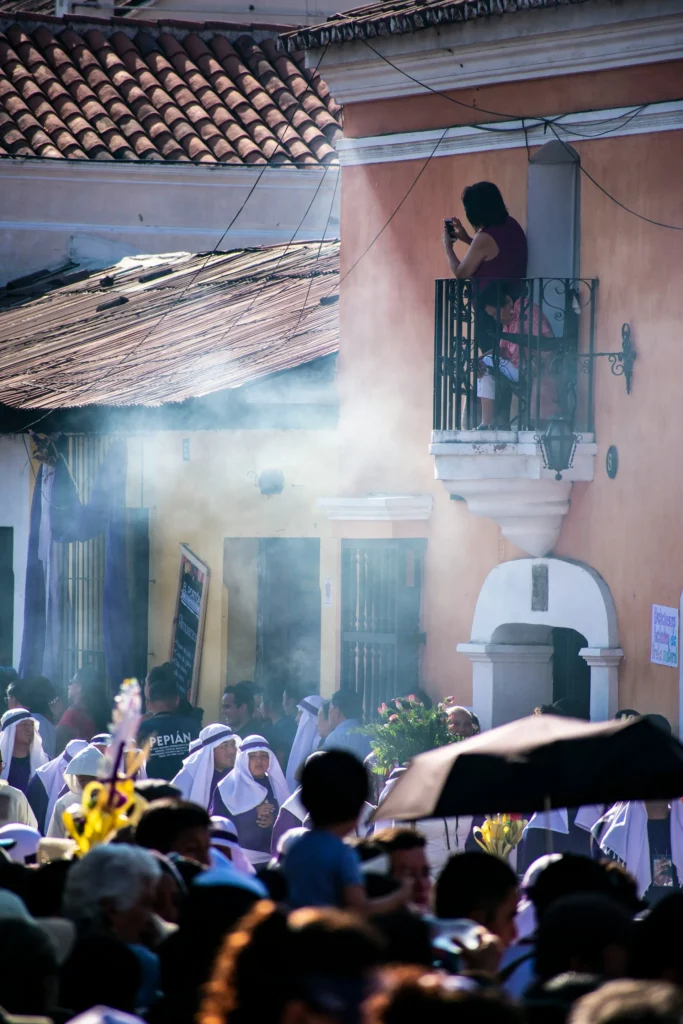
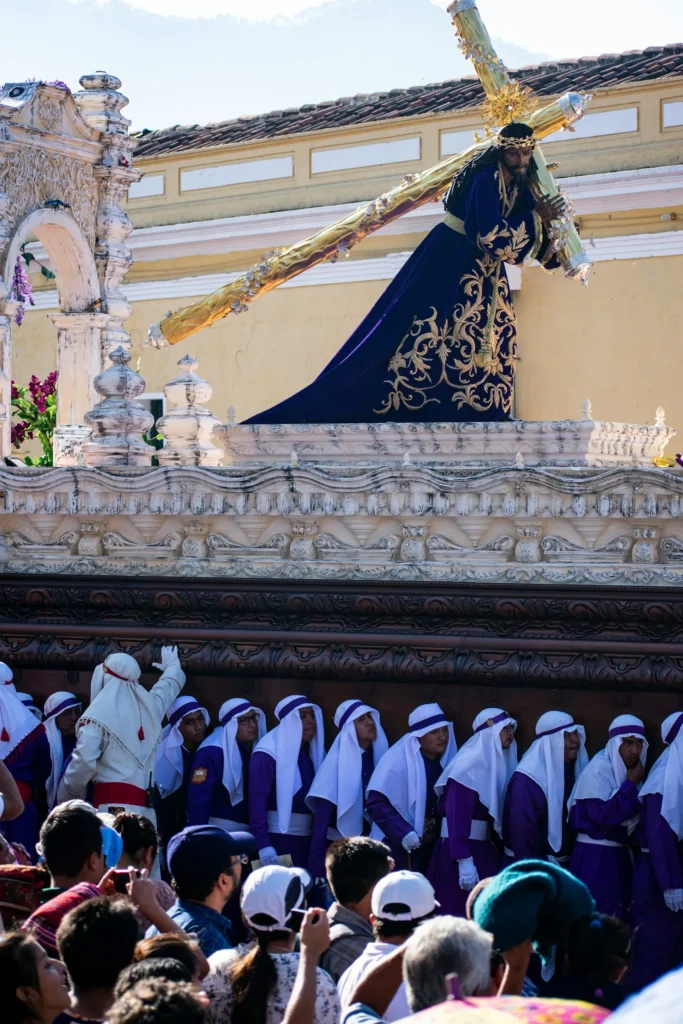
- When the funeral procession is in front of you, remain silent. This is the moment when the funeral marches ring out and the congregation focuses on prayer. Avoid speaking loudly or shouting.
- You can take photos, but please avoid using the flash if you are very close to the exhibits or inside dark temples.
- Don’t walk on the carpets. It seems obvious, but it’s the most common mistake tourists make.
Why is it worth experiencing Holy Week in Antigua Guatemala?
Because it's one of the most profound and moving cultural, artistic and spiritual experiences in the world. It's not just a festival; attending it becomes a deep immersion in a tradition with centuries of history.
Frequently Asked Questions about Holy Week in Antigua Guatemala
When is Holy Week celebrated in Antigua Guatemala?
Holy Week in Antigua Guatemala does not have a fixed date on the calendar as it is governed by the lunar cycles of the liturgical year, and is always celebrated between March and April.
What are the most important Holy Week processions in Antigua Guatemala?
The procession of Jesús Nazareno de la Caída (held on the fifth Sunday of Lent), Jesús Nazareno de los Milagros (which takes place on Palm Sunday), Jesús Nazareno de la Merced on Good Friday morning, the Holy Burial Processions on Good Friday afternoon, and Las Vírgenes de Soledad on Holy Saturday.