The Mesoamerican ballgame was much more than just a sport. It was ritual, it was politics, it was religion, and it was public spectacle. In Mayan cities, the ball court was not an architectural ‘extra’: it was a central stage where profound ideas about the order of the world, power and the relationship between the human and the sacred were enacted.
If you’re travelling through Petén and spot a ball court at an archaeological site, you’ll probably find yourself asking the same question everyone else does: what did it actually mean? In this guide, we explain the origins of the Mesoamerican ballgame, why it was so important, what it symbolised, what the courts were like, and where you can learn more about it in Guatemala. To help you plan your route around the country, here is the official Guatemala tourism website.
Why was the Mesoamerican ballgame so important to the Mayan civilisation?
Because the Mesoamerican ballgame encapsulated the worldview of an entire civilisation. It was not merely a physical contest: it was a way of expressing the balance of forces, the concept of cycles, the connection with the gods, and the legitimacy of power. In many cities, the game was incorporated into special occasions, ceremonies and moments of great symbolic significance.
Moreover, it was a social event of the highest order. The pitch brought together the community, the elite, the spectators and the players. It was a space where it was made clear ‘who was in charge’ and ‘why’, but also where the people saw a shared narrative played out. That is why the game is not seen merely as entertainment, but as an event with a public function.

And another key point: the game left its mark in stone. Courts, reliefs, stelae and scenes depicted on pottery show that this ritual was sufficiently ingrained to be depicted time and time again. If a practice appears repeatedly in architecture and art, it's because it held significant importance within the culture.
History of the Mesoamerican ballgame
The history of the Mesoamerican ballgame cannot be summarised in a single sentence. It's a broad Mesoamerican phenomenon which, within the Mayan world, takes on a meaning of its own and evolves according to region and era. What is interesting is that, although it changes, it retains a constant theme: the game serves as a representation of the world order and as a tool for cohesion (and, at times, tension) within political and religious life.
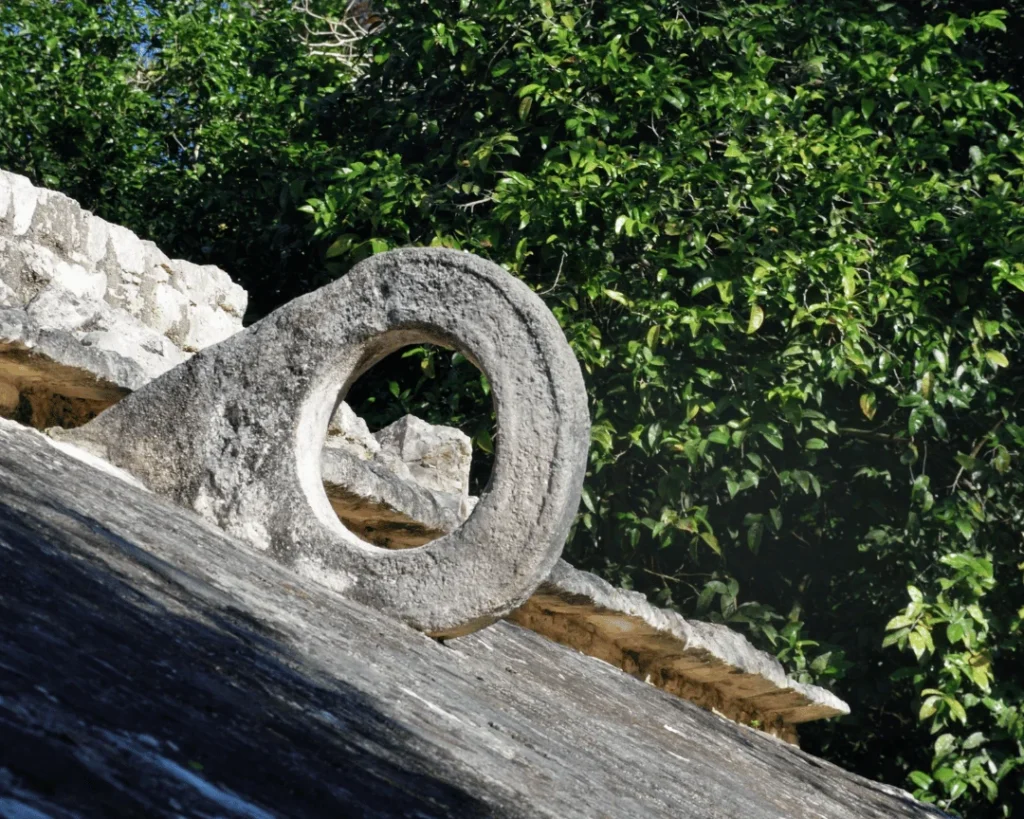
How did the Mesoamerican ballgame come about?
The game originated within a Mesoamerican cultural context in which the ball (and the act of playing with it) held symbolic significance. In the case of the Maya, it became a ritualised practice integrated into urban life: courts were built, spaces for the public were established, and the game was codified as part of the city’s ceremonial life.
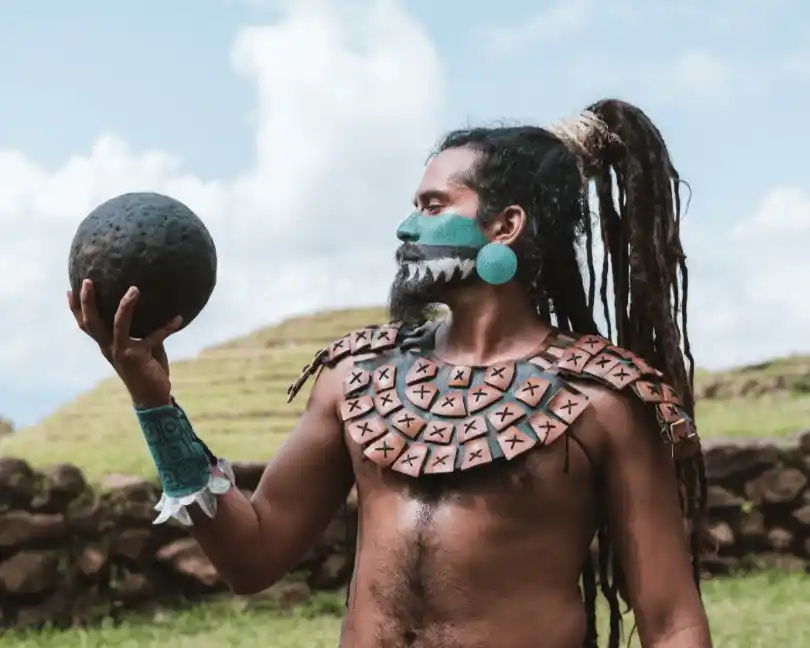
The ball, traditionally made of rubber, adds a fascinating element: it's a ‘living’ object in motion, heavy and bouncy, which demands technique and control. This physicality reinforces its symbolic value: it's not an easy game, and that difficulty is part of its power as a ceremonial act. In other words: effort and skill are not mere details; they are part of the message.
What role did it play in the political, religious and social life of the Mayan cities?
In political terms, sport could serve as a representation of authority and hierarchy. The elite did not merely govern; they also ‘staged’ power. And the pitch was one of the places where that representation became public and visible. In some contexts, the game is linked to alliances, rivalries and displays of status.
In religious terms, the Mesoamerican ballgame is linked to rituals and the worldview: the idea of cycles, of transition between worlds, and of opposing forces that balance one another. It's no coincidence that many ball courts are located near ceremonial plazas or structures of great significance. Architecture and ritual go hand in hand.
In social terms, the pitch is a meeting place. Not just to ‘watch the game’, but to be part of a shared experience. In Mayan cities, public life was deeply intertwined with collective rituals. The game was one of those experiences that built a sense of community.
How has the Mesoamerican ballgame changed over time?
It changed in form, emphasis and role within the city. In certain periods and regions, the ceremonial aspect was emphasised; in others, it was integrated differently into political life. The courts also evolved: their sizes, angles, architectural features and decorations reflected regional styles and historical periods.
The important thing is not to imagine a single ‘standard game’ for the entire Mayan civilisation. There were variations, adaptations and local differences. But the continuity of the phenomenon suggests that, even as it changed, the game remained a powerful cultural tool for representing central ideas of the Mayan worldview.
- We invite you to read our article about the history and culture of the Garifuna people.
The significance of the Mesoamerican ballgame
Here lies the crux of the matter: the significance of the Mesoamerican ballgame. If you view it as a sport, you miss the point. If you view it as a ritual, you understand why it was so important.
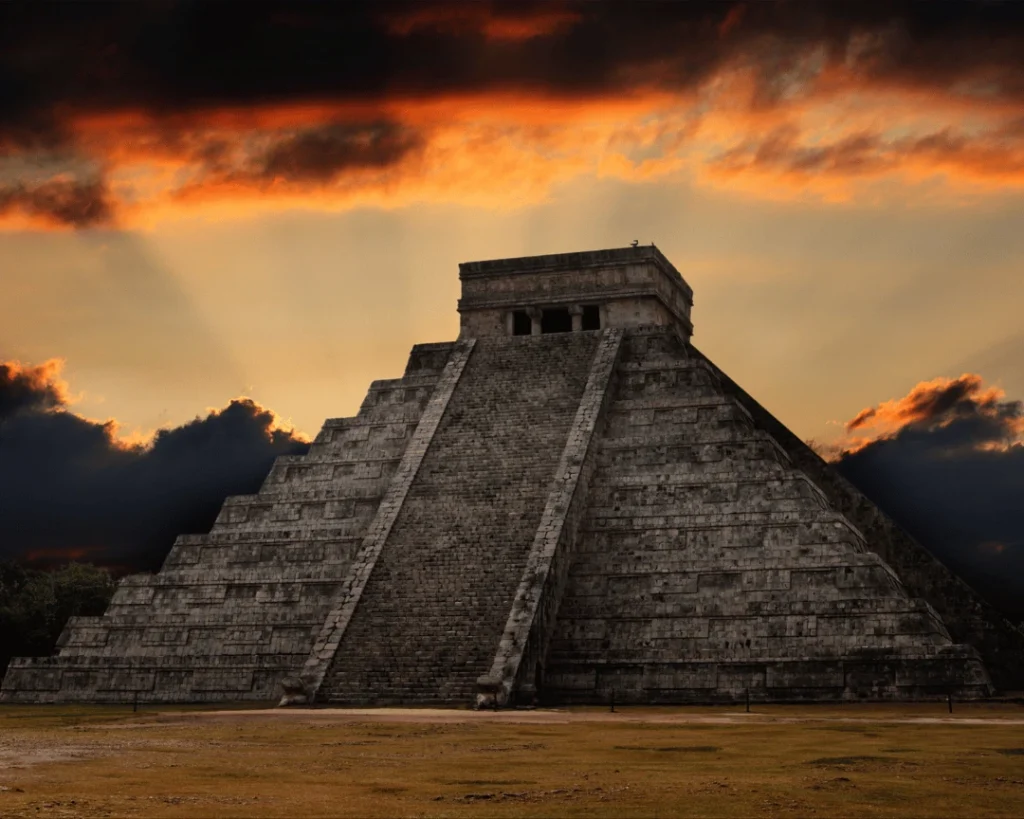
Religious symbolism, ritual and connection to the Mayan worldview
The game is linked to the concept of cycles: day and night, life and death, the passage of time, and the transition between realms. The ball is not merely an object: it's a symbol of movement and continuity. In many Mesoamerican depictions, the game is associated with mythological narratives and the relationship between complementary forces.
In the Mayan world, this connection to the worldview is reflected in the way the ball court is integrated into the ceremonial space. It isn't a separate place; it's a space where a worldview shared by the community was enacted.
The ceremonial significance of the game beyond sport
The ceremonial significance is evident in the surroundings: nearby squares, important buildings, reliefs and stelae. It's also evident in the fact that the game was played in significant settings, not merely for leisure. It was an event with rules, certainly, but also with ritual significance.
To understand this, it's therefore helpful to imagine it as a performance: players, an audience, music or ritual accompaniment (depending on the context), and an architectural space designed to ensure that the event made an impact. In the Mayan world, architecture ‘spoke’, and the court was part of that discourse.
Myths and representations of power surrounding the Mesoamerican ballgame
The ball game is also linked to mythical tales depicting symbolic struggles, trials and journeys between worlds. This reinforces the idea that the game was not merely a competition: it was a cultural narrative.
Furthermore, the game can serve as a representation of power: who participates, who organises, and who observes from certain vantage points. In a hierarchical city, public rituals are also a means of ordering the social world. The Mesoamerican ballgame, by virtue of its symbolic power, lent itself to serving as a setting for legitimisation.
What was a Mayan ball court like?
The court was designed as a space for ritual. Its shape, proportions and features made it both a functional and symbolic setting.
Structure, shape and main features of Mayan courts
Generally speaking, the courts usually feature an elongated central space, flanked by side structures. These structures could take the form of embankments, platforms or walls that marked the boundaries of the area and created a ceremonial corridor. In some cases, there are markers or specific elements associated with the game, as well as access points and spaces for the public.
Beyond its form, what matters is its function: the pitch draws the eye. It's designed to ensure the event is visible and so that the space ‘supports’ the ritual. Many pitches are located in central areas, reinforcing their public role.
What is known about the rules and dynamics of the Mesoamerican ballgame?
The exact rules varied by region and period, and much of our knowledge comes from depictions, reliefs and comparisons with other Mesoamerican games. The general idea is that the game involved keeping the ball in motion using various parts of the body, with skill and control, and that the gameplay had both a competitive and a ritualistic element.
Rather than fixating on a ‘single rule’, it's more useful to understand that physical difficulty and precision were part of the point: the ball was heavy, controlling it required skill, and the game became a display of discipline and dexterity, laden with symbolic meaning.
Differences between ritual games and other possible variations of the game
Within the Mayan and Mesoamerican world, there were various forms and uses of the game. Some practices are linked to specific rituals; others may have been more competitive or local in nature. In the case of the Maya, what stands out is the integration of the game into urban ceremonial life, suggesting that, at least in certain contexts, the ritual component was central.
This difference is evident in the architecture: a stadium situated at the ceremonial heart of a city is not the same as a more peripheral space. The location says a great deal about the role of the game.
Where to watch the Mesoamerican ballgame in Guatemala
One of the best ways to understand the Mesoamerican ballgame is to see a court in context, within an archaeological site. Guatemala is the perfect place for this, given its abundance of Mayan sites.
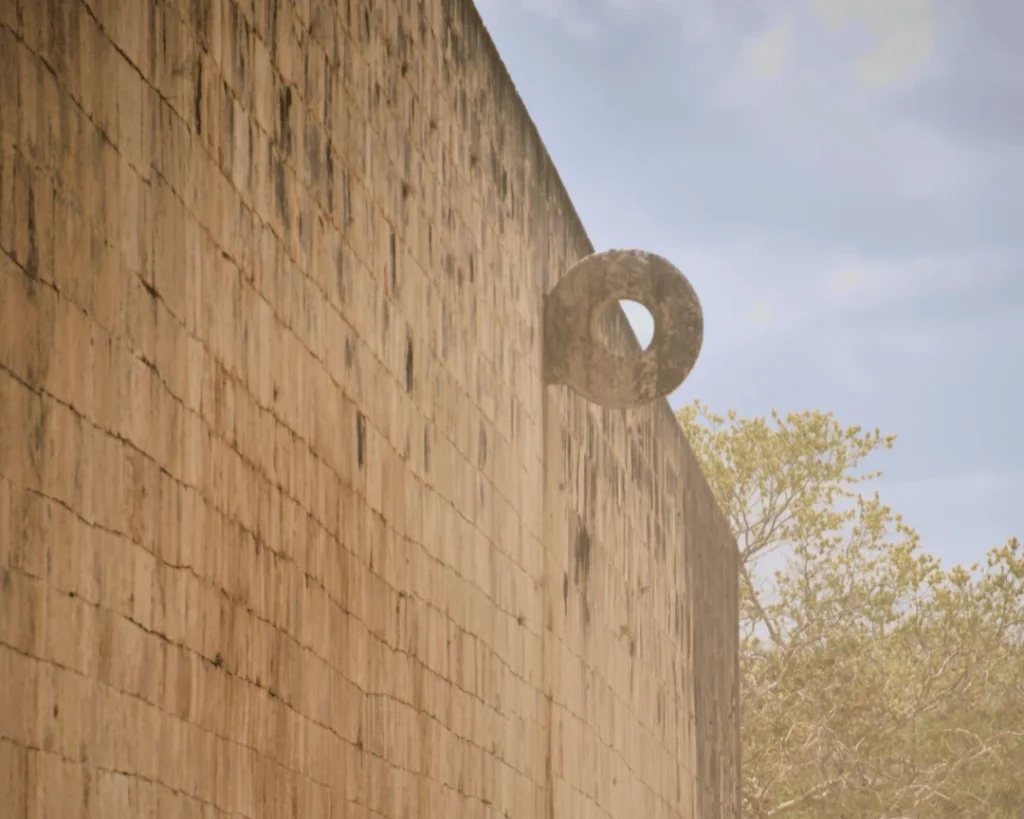
Archaeological sites featuring ball courts that help us gain a better understanding of this tradition
Seeing a court at an archaeological site helps you understand how it was integrated into the public space: its proximity to squares, its relationship with temples, and its role within the ceremonial ‘map’. To expand your cultural itinerary, you can use archaeological sites as reference points (so that you can link to them where appropriate).
If you’re planning a route through Petén, you might also find it useful to have the Tikal guide to hand to help you locate the key sites and organise your visit.
Tikal, Yaxhá and other sites where the Mesoamerican ballgame comes into its own
In Tikal, seeing the ballgame in context is a truly powerful experience because the city is monumental and its urban layout helps us understand how ceremonial activities were organised. To round off your visit, you can visit the Grand Plaza of Tikal, the heart of the National Park; the Temple of the Great Jaguar, Tikal’s most famous pyramid; and the Lost World of Tikal: one of the oldest complexes in the park.
At Yaxhá, the game also makes sense because of its connection to the lagoon, the viewing platforms and the ceremonial landscape. Taking your time to look around the city and then locating the court within the complex helps you understand that the game was part of a complete urban experience.
And if you’re interested in experiencing the park at a special time of day, this article provides the full emotional context of the place: Sunrise at Tikal: the park’s most magical experience.

Museums, visitor centres and places where you can learn more about the subject
If you’re looking for a deeper understanding, museums and visitor centres help to link architecture with its meaning: artefacts, reliefs, and explanations of worldviews and rituals. This is the sort of place that turns “I saw a court” into “I understand why it was important”.
The Mesoamerican ballgame and living culture in Guatemala
The Mesoamerican ballgame continues to capture people’s interest because it taps into something profound: we are not simply talking about an ancient sport, but a practice that reveals how a civilisation understood the world, time and power. For travellers, this becomes a cultural experience: walking across a court and imagining that myths, ceremonies and political tensions were once played out there.
Why does it continue to attract the interest of travellers?
Because it bridges the gap between ruin and meaning. Many people visit Mayan sites and focus solely on the architecture; the ball game forces you to go a step further and ask yourself about the significance of these spaces. What’s more, it evokes powerful imagery: ritual, community, worldview, narrative.
And there’s something else: the ball game is a story that lends itself well to being told. When a guide or a museum explains it clearly, visitors remember it, because it brings together myth, place and experience. It’s one of those topics that, once you understand it, changes the way you look at the entire Mayan city.
Frequently Asked Questions about the Mesoamerican ballgame
Was the Mesoamerican ballgame just a sport?
No. Although it involved skill and technique, the Mesoamerican ballgame was deeply intertwined with ritual, worldview and public life. In many cities, its ceremonial and symbolic role was central.
Do we know exactly how it was played?
General aspects are known from depictions, reliefs and comparisons with other Mesoamerican variants, but there is no single, fixed version applicable to every period and region. The important thing is to understand the logic: physical skill + ritual framework + architectural space designed for the event.
Where can I find a pelota court in Guatemala?
At various Mayan archaeological sites, particularly in Petén. Seeing it in context within a city such as Tikal or Yaxhá really helps to understand why the ball court was such an important space.